
Edited by Michael Anderson, Editor-in-Chief
Updated
Nagano Tonic Benefits: 5 Effects Users Notice
The five shifts buyers consistently report across the first 90 days of daily use — what changes, when it changes, and what the mechanism is behind each one.

One scoop in water every morning — five shifts users notice across the first 90 days.
In This Article
Benefits in 30 Seconds
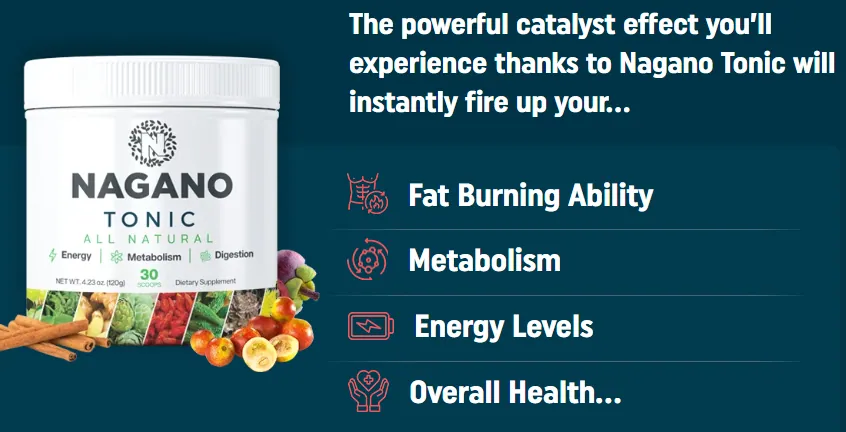
Nagano Tonic delivers five compounding shifts across 90 days — steadier afternoon energy in the first weeks (Vitamin B12 1042% DV + EGCG + adaptogens), fewer cravings as cortisol modulates (Ashwagandha + Bitter Melon), visible waistline change between week 8 and 12 (thermogenic + adaptogen synergy), calmer stress response (Eleuthero + Panax Ginseng), and lighter digestion (5-strain probiotic + enzymes). Not a stimulant spike. A daily morning ritual that builds in stages.
THE CORE PROMISE
If you’ve watched the belt notch creep the wrong direction while everything you used to do stopped working, the benefits below aren’t a stimulant high — they’re what happens when chronic stress hormone gets modulated and metabolism gets supported at the same time. Nagano Tonic skips the stimulant route entirely: a 30-second morning powder loaded with adaptogens (Ashwagandha, Eleuthero, Panax Ginseng) plus a 98% polyphenol Green Tea Extract delivering EGCG at clinical-trial concentration. Result: stress hormone steadied, fat oxidation supported, twelve whole-food antioxidants topped off — one scoop, every morning, for 60-90 days. That’s the whole promise.
1. Steadier All-Day Energy (Week 1-3)
The first benefit users notice — usually within the first two weeks — is the disappearance of the 3 p.m. wall. The slump that used to make a vending-machine snack feel inevitable starts arriving softer, then later, then not at all. Energy doesn’t spike; it just stops crashing.
Two ingredients drive this. Vitamin B12 at 1042% DV (as cyanocobalamin) addresses the low-grade B12 insufficiency common in adults over 40, which directly affects cellular energy production. And the adaptogen trio — Panax Ginseng, Eleuthero, Ashwagandha — supports the body’s ability to use stored energy without the rebound crash of caffeine. EGCG layers on a small thermogenic effect that keeps the metabolic engine running at a steady simmer all day.
What it doesn’t feel like: a pre-workout buzz. What it does feel like: still going at 4 p.m. with enough left in the tank to enjoy dinner instead of inhaling it.
2. Fewer Cravings & Snack Urges (Week 2-4)
By week three, most users report a noticeable drop in the kind of cravings that used to feel non-negotiable — the late-afternoon sugar pull, the after-dinner snack reflex, the “I’m bored, let me eat” loop.
The mechanism here is two-sided. Ashwagandha moderates chronic cortisol, which directly drives stress-eating in many adults. When the stress signal calms down, the food-as-coping pattern eases off. Meanwhile Bitter Melon (Momordica charantia) and Mangosteen support insulin sensitivity — keeping post-meal blood sugar curves flatter, which means fewer crashes that trigger the next snack. Cinnamon Cassia contributes the same way.
Reasonable expectation: not zero cravings (no formula delivers that honestly), but the muscle-memory pull around 3 p.m. and 9 p.m. gets quieter. Buyers describe it as “food becoming a decision again instead of a reflex.”
3. Slimmer Waistline (Week 8-12)
The visible body composition shift is the slowest-arriving benefit — and the one buyers wait the longest to see. The realistic window is week 8 to week 12 for the mirror change, and through 6 months for the full result the 180-day guarantee was designed around.
This benefit isn’t about a thermogenic burst. It’s about three pathways working in parallel for two months: cortisol modulation (Ashwagandha) reduces the stress-driven fat-storage signal around the midsection; EGCG-driven fat oxidation (50% catechin extract) supports the body using stored fat as fuel; and insulin sensitivity support (Bitter Melon, Mangosteen, Cinnamon) reduces the pattern of carbs being stored rather than burned.
What it looks like in real life: the belt notch holds steady for weeks, then eases the right direction. Clothes that felt tight in March fit easier by July. The mirror change your spouse notices before you do.
4. Calmer Stress Response (Week 4-8)
This is the benefit most weight-loss formulas completely miss — and the one that often surprises buyers most. Around week four to six, users report a noticeable softening of the stress reaction. Not numbness; just a wider window between the trigger and the spike.
Ashwagandha at meaningful daily doses has been studied in chronically-stressed adults for reductions in serum cortisol and improvements in perceived stress scores. Eleuthero (Eleutherococcus senticosus) and Panax Ginseng add the adaptogen layer — they don’t sedate you, they help the nervous system process stress without storing it.
The relevant point for weight loss: cortisol drives midsection fat storage independent of calories. If you’re a working adult under chronic low-grade stress, this single mechanism may explain more about why “diet alone” stops working past 40 than any calorie-math model would.
5. Lighter Digestion & Less Bloat (Week 2-4)
By the end of the first month, most users report cleaner digestion — the post-meal bloat that used to linger into the evening eases off, and morning puffiness fades.
The driver here is the Digestive Complex (406 mg) — Apple Fiber, Inulin from chicory root (prebiotic), Bromelain (pineapple enzyme), and Papain (papaya enzyme) — paired with a 5-Strain Probiotic blend at 2.5 billion CFU (L. Acidophilus LA85, B. Longum BL21, B. Bifidum BBi32, L. Casei LC89, L. Rhamnosus LRa05). The fiber feeds the probiotic strains; the enzymes help break down proteins in the foods you eat; the probiotic strains support gut barrier function over time.
Honest caveat: in the first week or two, a small minority of users notice a temporary uptick in gas or stool changes as the gut adjusts to the new strains. This typically settles by week three. If it lasts longer, drop to a half-scoop for a few days and ramp back up.
Realistic Timeline Summary
| Window | What shifts |
|---|---|
| Week 1-2 | Energy steadier through the afternoon; first signs of the 3 p.m. wall softening |
| Week 2-4 | Cravings drop noticeably; bloating eases; digestion lighter post-meal |
| Week 4-8 | Stress response calmer; sleep deeper; first scale signal in some users |
| Week 8-12 | Visible waistline change; clothes fit differently; mirror finally catches up |
| Month 4-6 | Full evaluation window; the result the 180-day guarantee was designed around |
Pricing Options for Nagano Tonic
Nagano Tonic is available in three bundle options. Most users choose the 6-bottle bundle because the adaptogen + thermogenic system needs 60-90 days of consistent daily use to register in the mirror and the scale. The 6-bottle bundle locks in $39 per bottle, includes free shipping plus 3 bonuses, and covers the full evaluation window with margin to spare.
1 Bottle
30-Day Supply
- 180-Day Money-Back Guarantee
- Secure Checkout
3 Bottles
90-Day Supply
- 180-Day Money-Back Guarantee
- 3 FREE Bonuses
- Anti-Aging + Sleep + Smoothie Guides
Save $204
Shop Now6 Bottles
180-Day Supply
- 180-Day Money-Back Guarantee
- Free US Shipping
- 3 FREE Bonuses
Save $528
Shop NowEvery order is backed by a 180-day money-back. Only available through the official website.
Frequently Asked Questions
How quickly do the benefits actually start?
The first benefit (steadier energy) typically registers within the first 7-14 days, driven by B12 + adaptogen action. Cravings and digestion shifts follow in weeks 2-4. Visible waistline change is week 8-12 — that’s the slow-build part. If you’re looking for a 7-day visible body change, this isn’t the formula. If you want compounding shifts that stick because they didn’t depend on a stimulant, the 60-90 day window is honest.
Which benefit is the most reliable across users?
Steadier energy and fewer cravings are the two shifts that show up most consistently in buyer feedback — they happen early and don’t depend on dietary discipline. The waistline change is the most variable because it depends on baseline weight, stress levels, sleep, and how much processed food stays in the daily diet. Calmer stress response is the “sleeper” benefit — buyers often don’t realize it’s shifted until something stressful happens and they don’t react the way they used to.
Can I get the same benefits by drinking green tea + taking Ashwagandha separately?
In theory, partially — but the dosing math doesn’t work out. Nagano Tonic’s Green Tea Extract is standardized to 98% polyphenols / 50% EGCG, which would require roughly 10-15 cups of brewed green tea to match per serving. The adaptogen blend delivers Ashwagandha, Panax Ginseng, and Eleuthero in one scoop — buying each separately runs $40-60 for a 30-day supply, before you’ve added the greens, probiotic, or B12. The value of the powder format is loadability, not novelty.
Continue your research
- Next: What’s inside Nagano Tonic — full ingredient breakdown with doses and roles
- Then: Does it really work? — mechanism + week-by-week timeline
- Compare: Ikaria Juice — same powder format, polyphenol + 9-strain probiotic angle instead of adaptogen-driven
- Deep dive: Best natural alternatives to GLP-1 weight loss drugs — where Nagano Tonic fits in the broader category
Research & Transparency
This content is based on publicly available ingredient research, manufacturer disclosures, and product labeling. We are not affiliated with the manufacturer.
(a) Ashwagandha (Withania somnifera) for stress, cortisol reduction, and body weight management in chronically stressed adults — randomized controlled trial. PMC5934947
(b) Green tea catechins (EGCG) and body composition — meta-analysis of randomized controlled trials. PMC2855614
(c) Panax ginseng influence on obesity and gut microbiota in obese middle-aged Korean women — randomized clinical trial. PMC4003844
(d) Eleuthero (Eleutherococcus senticosus) endurance capacity and metabolism in humans — clinical investigation. PubMed 20355297
(e) Mangosteen extract insulin sensitizing effect in obese female patients — prospective randomized controlled pilot study. PubMed 30144384
About the Author
Emily Carter is a contributor at The Supplement Post covering brain and neuro health, blood sugar control, weight loss, and gut-focused formulas. She specializes in evidence-aware summaries of nootropic ingredients, metabolic supplements, and consumer-friendly explanations of how supplementation fits into broader cognitive and metabolic health strategies. Emily Carter is not a medical doctor — she analyzes publicly available research to provide evidence-aware summaries for adults exploring cognitive support, metabolic balance, and gut wellness options.
Disclosure
All content is for informational purposes only and is not a substitute for professional medical advice. Each product reviewed is a dietary supplement, not a prescription drug. Results may vary based on individual health status, consistency of use, and lifestyle. This page may contain affiliate links — if you purchase through them, we may earn a small commission at no additional cost to you. Read our Editorial Policy.