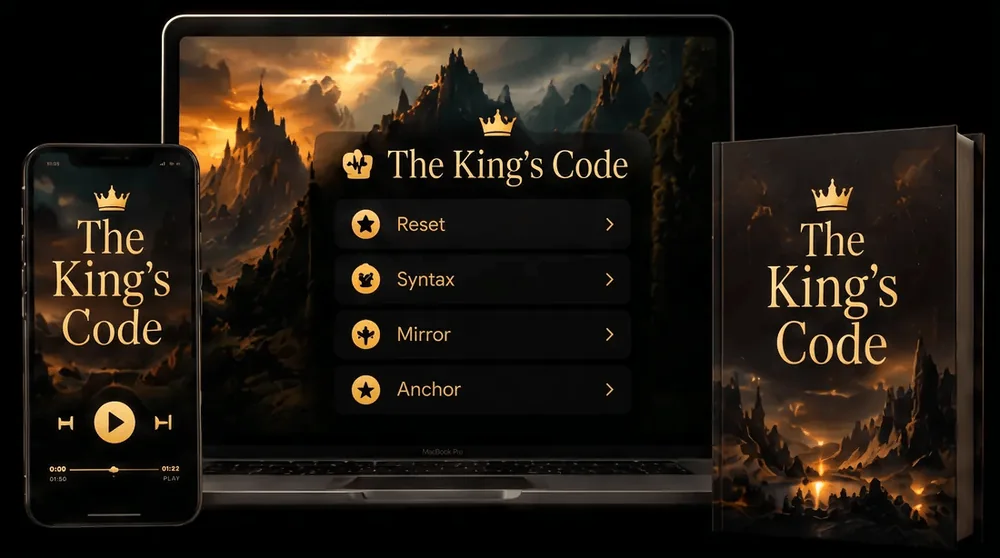
What does The King's Code do for affirmations that never feel true? It swaps repeating words you don't believe for a 15-minute daily practice in four phases, Reset, Syntax, Mirror and Anchor, built around your goal. It works on the picture you hold of yourself, so the words stop arguing with you. One payment of $97, 60-day guarantee.
In This Review:
- 1. Product at a Glance
- 2. What You Get, Exactly
- 3. How the Method Works
- 4. Do Daily Affirmation Practices Work?
- 5. The Field Behind the Method
- 6. What Changes, and When
- 7. Why It Earns 4.6 / 5
- 8. Who It's Best For
- 9. Isn't This Free on YouTube?
- 10. Price, Guarantee and the Subscription Question
- 11. Final Verdict
- 12. FAQs
Updated
1. Product at a Glance
| Product | The King's Code |
| Category | Daily mindset practice for affirmations that don't feel true |
| Format | App, a guided practice of about 15 minutes a day |
| How it works | Four phases in a fixed order, built around your goal and profile, so the words you say match the picture you hold of yourself |
| The four phases | Reset, Syntax, Mirror and Anchor |
| Payment | $97, one payment. No subscription |
| Guarantee | 60-day money-back guarantee through the official site |
| Our Rating | 4.6 / 5 |
Quick Verdict
Does The King's Code help when affirmations feel untrue? Yes, if what stalled is belief and not effort. You say the sentence and something in you answers "sure you do." The King's Code goes after that answer. In about 15 minutes a day, four phases in a fixed order build the words around your goal, so you press play instead of facing a blank page. It is one payment, with no subscription, and 60 days to decide if it is for you.
2. What You Get With The King's Code, Exactly
The King's Code is one product: an app that guides a daily practice. This is everything that comes with the purchase.
| What | Details |
|---|---|
| What it is | An app that guides a daily practice. You open it and press play. |
| The protocol | Four phases in a fixed order: Reset, Syntax, Mirror and Anchor. |
| How it is built | Around your goal, your routine and your profile. There is no script to write. |
| A day looks like | A short cycle of Reset, Syntax and Mirror, closed by an Anchor review in the evening. |
| How long a day takes | About 15 minutes. |
| Where you use it | On your phone. |
| What it costs | $97, one payment. No subscription and no renewal. |
| The guarantee | 60-day money-back guarantee through the official site. |
That is the whole purchase: the app and the protocol inside it, one payment, and 60 days to try it.
3. How The King's Code Works: Four Phases in a Fixed Order
An affirmation asks you to repeat something you do not yet believe. The King's Code works on the part of you that decides whether you will: the picture you hold of who you are. Words aimed at the result slide off. Words aimed at the picture hold.
The four phases do that in order, and the order is the method. Every day runs the same way, so you never have to decide what comes next.
| Phase | When | What it works on |
|---|---|---|
| Reset | Daily cycle | Where you start from, before any words come in. |
| Syntax | Daily cycle | The gap between the words you say and what you believe. |
| Mirror | Daily cycle | How you see yourself saying it. |
| Anchor | Evening | What the day leaves behind, so tomorrow does not start from zero. |
This page tells you what each phase works on. How to run them is what the app is for.
Why four phases and not one
One repeated sentence asks a lot of a single step. Four phases share the job, each aimed at a different part of the problem, so nothing is left to improvisation.
4. Do Daily Affirmation Practices Actually Work?
Do daily affirmation practices actually work? They can, and the research is encouraging about the family of practice The King's Code belongs to. A 2025 meta-analysis of 67 published articles in American Psychologist found that self-affirmation practices have positive, lasting effects on how people see themselves and on their well-being. Adults gained more in self-perception than adolescents did.
The habit behind the app is older than the app. Writing a line to yourself in the first person and keeping it in sight is well documented. CBS News reported a note Michael Jackson wrote at 21 on the back of a tour itinerary: "I will be magic." Rolling Stone described another that reads "I want to be the greatest entertainer of all time." The King's Code is its own app and protocol, not his, and no endorsement is implied. It takes its cue from the practice, not from the man.
So the bar this page holds The King's Code to is simple. Does it turn that habit into a structure you can follow every day, with words built around you? The next sections show how it does.
5. The Field Behind the Method
The King's Code works in a territory with a long shelf of authors. Here is who formulated the main ideas, in their own books and in their own terms.
| Idea | Who and where | In the author's terms |
|---|---|---|
| Self-image | Maxwell Maltz, Psycho-Cybernetics (1960) | Self-image, a term he popularized, strongly affects whether a person reaches a goal. |
| A brain that changes | Norman Doidge, The Brain That Changes Itself (2007) | Neuroplasticity: the brain can change its own structure, against the older view that it is fixed. |
| Beliefs about yourself | Carol Dweck, Mindset (2006) | What people believe about their abilities shapes how they learn and what they pursue. |
| Mirror work | Louise Hay, Mirror Work (2016) | The Mirror Principle: our experience of life mirrors our relationship with ourselves. |
| Belief and the body | Bruce Lipton, The Biology of Belief | Argues that signals from outside the cell, including messages from our thoughts, influence how cells function. |
| The language of the field | Joe Dispenza, Breaking the Habit of Being Yourself | Draws on quantum physics, neuroscience, biology and genetics to describe changing who you are. |
The last two borrow words from physics and biology to talk about the mind. That is how the field speaks, and these are the authors' views in their own books. The King's Code asks you to accept none of it. It works on one thing: the picture you hold of yourself.
6. What Changes With The King's Code, and When
The King's Code solves one problem: the words you say and the person you believe you are do not match. You say "I am a magnet for opportunity," and some part of you answers back. So the line slides off, and the next day you reach for different words.
Nothing you tried was wrong. A piece was missing: a way to work on the picture you hold of yourself, and not only on the words. That is what the four phases add. Syntax works on the gap between the words and what you believe, Mirror on how you see yourself saying them, and Anchor on what the day leaves behind. See the four phases in order.
By the producer's account, the first change sits inside the first 15 minutes: a line you can say without flinching. From there, each day adds one more cycle and one more evening review. The 60-day guarantee covers two full months of them, which is enough days to see how the practice sits with you.
7. Why It Earns 4.6 / 5
It gives affirmations what they usually lack: a fixed order, words built around you, and a short daily practice that ends with a review.
What stands out:
- A method with an order — four phases that always run the same way, so you press play instead of facing a blank page
- Words built around you — the protocol adapts to your goal, routine and profile, with no script to write
- Aimed at the picture, not only the words — it works on the part of you that decides whether a line sticks
- A day that closes — the evening Anchor review turns each session into a finished cycle
- One payment, no subscription — $97 once, so the price you see is the whole price
- 60-day money-back guarantee — through the official site
Worth knowing:
- About 15 minutes a day — the practice works best when it has a regular slot in your day
Full scorecard across all 6 criteria: The King's Code Scorecard →
8. Who Is The King's Code Best For?
Best match if you:
- Know what you want and keep drifting away from it.
- Have said affirmations and felt nothing, and want the words built around you.
- Like to press play and be guided instead of starting from a blank page.
- Can give a short routine a place in the day, about 15 minutes.
Look at alternatives if you:
- Would rather start with a pen and one sentence. A notebook costs nothing, and the app is there when you want the structure.
- Want a one-sitting fix. This is a daily practice, so what it builds shows across days.
- Are looking for medical or therapeutic care. The King's Code is educational self-development. If you are going through a hard stretch, talk to your doctor or therapist and use it alongside their care.
9. Isn't This Free on YouTube? How The King's Code Compares
Isn't there free affirmation content? Yes, and plenty of it. Free videos hand you someone else's words, read to everyone at once, with no order and nothing that closes the day. That is why most people who start there drift: there is nothing holding the practice together. What you are paying for is the structure.
And most people who get this far have already paid for something else first. Here is what those cost, against what this one does, with the figures as the presentation lays them out.
| What people already spend | What it costs |
|---|---|
| 12 sessions with a licensed therapist | ~$2,400 |
| 90 days of identity coaching | $5,000–$15,000 |
| The courses, programs and retreats most people here already bought and never finished | $800–$3,000 |
| A self-help app subscription | Forever |
 The King's CodeThis review | $97 once |
| Where to buy | Official Site → |
No monthly charge. No subscription. No renewal. No fine print. You pay once and the app is yours — which is what separates it from the row above: a subscription keeps taking money for as long as you keep it, and switches your progress off the day you stop paying. Figures as presented in the video; therapy is a different thing, and sometimes it is exactly what a person needs.
10. Price, Guarantee and the Subscription Question
The King's Code has one price: $97, paid once. It is not a subscription, so there is no monthly charge and no renewal to cancel. The guarantee gives you 60 days, which is sixty full cycles of the practice, each with its evening review. That is enough to judge it from the inside.
The King's Code
The App, Four Phases
- Secure Checkout
Every order is backed by a 60-day money-back guarantee. The official site is where the guarantee is honored.
12. Final Verdict
Is The King's Code worth trying if affirmations never felt true? Yes, if what is missing is a way in and not more effort. Here is how this applies to you. You say the line you want to live by, and a quiet voice answers "not yet." So you try new words, and they slide off the same way. It never feels like a problem with a name. It feels like you, unconvinced by yourself.
That is one problem, and it is not the words. The idea behind the app is simple: your mind acts from the picture it holds of who you are, so a line aimed at the result argues with that picture. The King's Code works on the picture. Four phases, each aimed at a different part of that picture, run in a fixed order and close the day. That is also why the words are built around your goal and profile.
A daily practice is judged across days, and the guarantee gives you 60 days: sixty full cycles, each with its evening review. That is long enough to know whether the order and the words work for you, and the guarantee runs through the official site, so the risk of finding out sits with the producer. Given all of that, the simple move is to start the practice and follow it as written: a short daily cycle of Reset, Syntax and Mirror, then the Anchor review in the evening, about 15 minutes in all. It is one payment of $97, with no subscription to cancel.
12. Frequently Asked Questions
Does The King's Code really work?
It gives affirmations what they usually lack: a fixed order of four phases and words built around your goal and profile. It works on the picture you hold of yourself, so the words have something to land on. It is a daily practice, and how far it takes you depends on how steadily you keep it. The 60-day guarantee gives you time to find out.
Why do my affirmations feel untrue?
A sentence aimed at the result asks you to say something you do not yet believe, and some part of you answers back. The King's Code starts from the picture you hold of who you are, so the line you say is one you can say without flinching.
Do I have to write my own affirmations?
No. The app does the personalising, adapting the protocol to your goal, routine and profile, so there are no scripts to write. You open it, press play, stand at the mirror and close the day.
How does a day with The King's Code go, and how long does it take?
About 15 minutes. A short cycle of Reset, Syntax and Mirror, closed by an Anchor review in the evening. The four phases always run in that order.
Is The King's Code a subscription, and what does the guarantee cover?
It is not a subscription. It is one payment of $97, with no monthly charge and no renewal. The 60-day money-back guarantee runs through the official site: if the practice is not for you, you ask for a refund there.
When should I talk to a doctor or therapist?
The King's Code is educational self-development, not medical or psychological care. If you are going through a hard stretch, such as persistent anxiety or low mood, talk to your doctor or therapist and use the practice alongside their care.
FORMAT
Sources & Transparency
This content is based on the producer's official offer and checkout, publicly documented sources, published research and the authors' own books, named as the authors' views. Our editorial team works independently of the producer.
(a) Zhang Y, Chen B, Hu X, Wang M. The impact of self-affirmation interventions on well-being: A meta-analysis. American Psychologist (2025)
(b) 60 Minutes Overtime staff. MJ's "manifesto," penned in 1979. CBS News (2013)
(c) Fear D. Spike Lee on His New Michael Jackson Doc and Going After MTV. Rolling Stone (2016)
(d) Maltz M. Psycho-Cybernetics. Penguin Random House (Tarcher)
(e) Doidge N. The Brain That Changes Itself. Penguin Random House (Penguin Life)
(f) Dweck CS. Mindset: The New Psychology of Success. Penguin Random House (Ballantine)
(g) Hay L. Mirror Work: 21 Days to Heal Your Life. Hay House
(h) Dispenza J. Breaking the Habit of Being Yourself. Hay House
(i) Lipton BH. The Biology of Belief. Hay House
Disclosure
All content is for informational purposes only and is not a substitute for professional medical, psychological or financial advice. The King's Code is educational self-development content, not a medical or psychological treatment. Results vary with your goal, your routine and how consistently you practice. This page was written and reviewed by The Supplement Post Editorial Team and may contain affiliate links — if you purchase through them, we may earn a small commission at no additional cost to you. Read our Editorial Policy.