In This Review:
Edited by The Supplement Post Editorial Team, Editorial Review
Updated
1. Product at a Glance
| Product | Sonnus |
| Category | Sleep & Stress / Staying Asleep / Gummies |
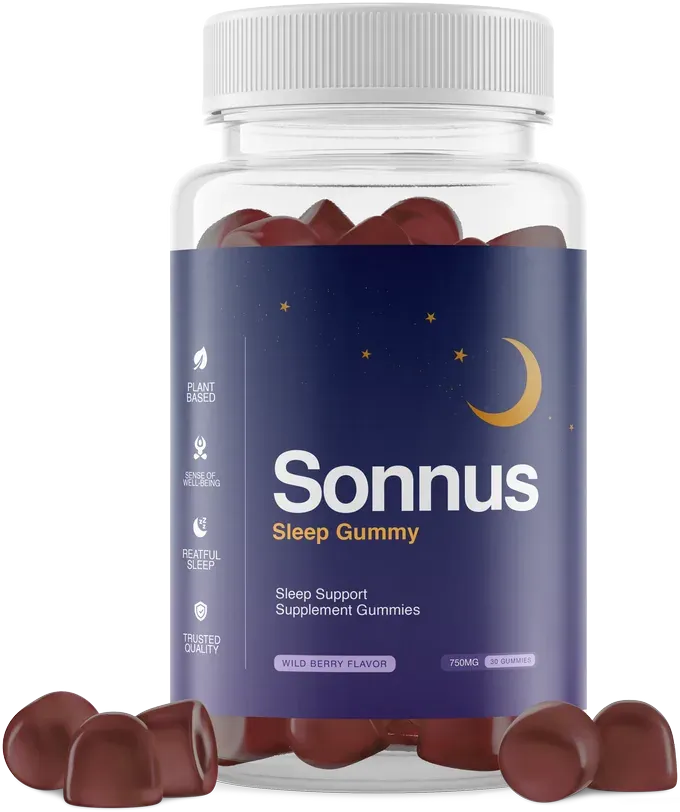
| Format | Wild-berry gummies — a 30-count bottle taken as two gummies about 30 minutes before bed, with no sugar added. At that pace a bottle covers 15 nights, which is why the package you choose matters more here than with a once-nightly capsule. |
| Key Ingredients | Magnesium bisglycinate at the base, with L-theanine, GABA, apigenin, 5-HTP, lemon balm, B vitamins and a 0.9 mg melatonin signal |
| Manufacturing | Made in the USA in an FDA-registered facility with every batch third-party tested. No added sugar, and no stimulant of any kind. |
| Guarantee | 90-day money-back |
| Our Rating | 4.6 / 5 |
Quick Verdict
Sonnus is built for the half of the night most sleep aids ignore. Falling asleep is the easy part. Staying asleep is where the night gets lost, and that is a different problem with a different answer.
The base of the formula is magnesium bisglycinate, and it is the ingredient here with real human evidence behind it. A 2025 randomised, double-blind, placebo-controlled trial followed 155 adults with poor sleep and found a significant improvement over placebo — modest rather than dramatic, and larger in people whose diets were low in magnesium to begin with.
Around it sit L-theanine, GABA and apigenin for the mental noise, lemon balm and B vitamins for the physical wind-down, and a low 0.9 mg melatonin at the end as a night signal.
What buyers mention first is not falling asleep faster. It is the morning — waking without the flattened feeling that strong sleep aids leave behind. Two gummies about half an hour before bed, no added sugar, no stimulant anywhere in it.
2. Waking at 3 a.m.: Evidence, Concerns & Trends
Before the formula itself, here is what the evidence, the common worries and the current market actually show about waking in the middle of the night.
| What people wonder | What the evidence shows | What it means for you |
|---|---|---|
| “Am I the only one lying awake at 3 a.m.?” | No. CDC figures put more than a third of US adults below the recommended amount of sleep, and short sleep is most common in the middle decades of adult life. | You are in the largest group there is, not an unlucky exception. It also means most products are aimed at the crowd, which is why so few of them address the middle of the night. |
| “Does magnesium actually do anything, or is that just a supplement story?” | It has been tested properly. A 2025 randomised, placebo-controlled trial in Nature and Science of Sleep gave 155 adults magnesium bisglycinate and measured them against placebo on the Insomnia Severity Index. The magnesium group improved significantly more — with a modest effect size. | This is not folklore. It is also not a miracle: modest means modest. Worth knowing that people with low dietary magnesium improved the most. |
| “Why do the strong ones leave me foggy?” | Grogginess the following day is the most common reason people abandon sleep products altogether — the trade being made is a night of sleep for a compromised morning. | If that is your history, the question to ask about any product is not how fast it works but how you feel at 7 a.m. That is the measure that decides whether you keep taking it. |
Where Sonnus fits: it is a multi-ingredient formula anchored on the one sleep nutrient with a placebo-controlled trial behind it, aimed at the middle of the night rather than the first twenty minutes of it. That is a narrower promise than the category usually makes, and it is the one the formula can stand behind.
3. What Sonnus Does and Benefits
Sonnus is built for the night that breaks in the middle, not the one that will not start. Those are two different problems, and almost everything on the shelf is built for the first one.
If you fall asleep fine and wake at 3 a.m. with your head already running, more of what makes you drowsy is not the answer. You were not short of drowsy. You were short of a night that holds.
That is the version people describe. Asleep by eleven without trouble. Awake at three for no reason you can name. The ceiling, the clock, the arithmetic of how many hours are left. Then the alarm, and a day spent paying for it.
Sonnus works on the whole night rather than the doorway to it. Magnesium bisglycinate at the base, with the calm-down ingredients around it and a low melatonin signal at the end. Two gummies about half an hour before bed, wild berry, no sugar added.
What changes, when it changes, tends to arrive in an order: the wind-down first, the morning second, the middle of the night after that. Made in the USA in an FDA-registered facility, every batch third-party tested, with 90 days to decide.
4. Why We Rate It 4.6 / 5
The base ingredient here has something most of this category cannot claim: a randomised, double-blind, placebo-controlled trial in people, on the exact form used. That trial found a real improvement and a modest one, and both halves of that sentence matter.
The formula also has a shape. Four steps — raw material, mental quiet, physical release, night signal — rather than a long label hoping one thing lands. There is no stimulant in it and no added sugar, and it is made in the USA in an FDA-registered facility with third-party testing on every batch.
What keeps it from going higher is honest to say: outside the magnesium, the human evidence per ingredient thins out. L-theanine, GABA and apigenin are here for the wind-down, and the research behind them is lighter than the research behind the base. The formula is well built; not every part of it is equally proven.
- A base ingredient with a placebo-controlled trial. 155 adults, magnesium bisglycinate, measured on the Insomnia Severity Index — real evidence, honestly modest.
- Built for staying asleep, not just falling asleep. The part of the night most products skip.
- The morning is what buyers mention first. Waking without the flattened feeling is the most repeated theme in the reviews.
- No stimulant, no added sugar. Nothing in it to work against the thing you are trying to do.
- 90 days to decide, and 90 nights of product. The three-bottle package covers the guarantee exactly.
- The evidence is strongest at the base and lighter above it. Magnesium bisglycinate carries the placebo-controlled trial; the wind-down ingredients rest on lighter research.
- Built for the middle of the night, not for falling asleep in ten minutes. If dropping off is the part you struggle with, a different door fits better.
- A run of bad months is a doctor’s question, not a gummy’s. This is aimed at the ordinary broken night, not at insomnia that has been going on for a long stretch.
5. Who Is Sonnus Best For?
Best match if you:
- Fall asleep without much trouble and lose the night somewhere around 3 a.m.
- Have tried something strong, slept, and spent the next morning underwater
- Get into bed physically tired with a head that is still going
- Can give it the full three months rather than three nights
- Want something without a stimulant and without added sugar
Look at alternatives if you:
- You snore heavily and wake unrefreshed no matter how long you sleep. That points at apnoea, and it needs a diagnosis rather than a gummy.
- You take antidepressants, triptans or tramadol and have not spoken to your doctor about 5-HTP.
- You want to be knocked out. This is built to do the opposite, and any product that promises it should worry you.
- You are already on a prescription sleep medication. That conversation belongs with the doctor who wrote it.
6. How It Compares
Three products, three honest routes to a better night. Which one fits depends less on scores than on what is taking the night away from you.
| Criteria | Sonnus | CBD Care Gummies | Advanced Memory Formula |
|---|---|---|---|
| Primary focus | Staying asleep through the night | Calm first, sleep as a result | Daytime clarity and focus |
| Format | Gummy, two before bed | Gummy | Capsule |
| Best for | The 3 a.m. ceiling | A mind that will not stop racing | Foggy days that follow bad nights |
| Guarantee | 90 days | See review | See review |
Full reviews: CBD Care Gummies Full Spectrum · Advanced Memory Formula
None of these is a runner-up. CBD Care Gummies come at the night from the anxiety side, which is the right door if what keeps you up is a mind that will not stop rather than a body that will not settle — and for some people that is exactly the problem. Advanced Memory Formula is not a sleep product at all; it is for the fog that a run of bad nights leaves behind during the day, and it does that job well. Sonnus is the one aimed at the middle of the night itself. Three tools for three different parts of the same tired week.
7. Pricing Options for Sonnus
The first nights feel like nothing much — an easier wind-down at eleven, and not much else — which is why a few nights tells you almost nothing. What buyers mention is the morning, and mornings take weeks to change. One bottle is thirty nights. Two bottles at $54.98 doubles that. Given all of that, three bottles at $39.98 each is the one we would take: ninety nights, which is enough for a sleep pattern to actually settle.
1 Bottle
30-Day Supply
- One-time purchase — no subscription
- Secure Checkout
Full price — no discount applied*
See Today’s Discount →3 Bottles
90-Day Supply
- One-time purchase — no subscription
- Covers the full window the brand publishes
- Secure Checkout
Full price — no discount applied*
See Today’s Discount →2 Bottles
60-Day Supply
- One-time purchase — no subscription
- Secure Checkout
Full price — no discount applied*
See Today’s Discount →Every order is backed by a 90-day money-back guarantee. The official site is the only channel that guarantees an authentic bottle and honors that refund.
* The prices above are the full prices, before any discount. The official page runs its own offers on top of them, each tied to a limited number of units — and it is the only place the discount running today can be confirmed.
8. The Mechanism: Why Four Steps, Not One Ingredient
Sonnus does not run on one ingredient. It runs in four steps, and the order is the point.
First the raw material. Magnesium bisglycinate is magnesium bonded to two glycine molecules, which is what makes it gentler on the stomach than the oxide form most cheap supplements use. It is also the step with the placebo-controlled trial behind it.
Then the quiet. L-theanine is the amino acid from green tea, the reason a cup settles you without making you drowsy. Apigenin is the compound in chamomile behind the bedtime-tea reputation. GABA is the brain’s own brake signal.
Then the release. Magnesium again, with lemon balm — the traditional evening herb — for the physical side of letting go.
And the signal last. A low 0.9 mg of melatonin, the compound the body releases as evening comes on. It sits at the end of the sequence rather than at the front, which is what makes this a formula rather than a melatonin product with extras.
What these terms actually mean:
- Bisglycinate
- Magnesium with two glycine molecules attached, like a coat that gets it through the stomach in one piece. It is the reason this form does not upset people the way cheaper magnesium does.
- Insomnia Severity Index
- A short questionnaire researchers use to put a number on how bad someone's sleep is. When a trial says sleep “improved”, this is usually what moved.
- L-theanine
- The amino acid in green tea. It is why tea can settle you down without the heaviness of something that makes you drowsy.
- Apigenin
- The compound in chamomile. When people say a cup of chamomile helps them wind down, this is the part they are talking about.
Full Ingredient List
There is no published Supplement Facts panel for Sonnus, so what follows is the formula as the manufacturer describes it, ingredient by ingredient, with the research named where research exists. Where it does not, this says so plainly.
| Ingredient | Pathway | Role in the Formula |
|---|---|---|
| Magnesium Bisglycinate | Step one — the raw material | The base of the formula, and the ingredient here with the most direct human evidence behind it. A 2025 randomised, double-blind, placebo-controlled trial in Nature and Science of Sleep gave 155 adults reporting poor sleep 250 mg of elemental magnesium daily and measured them on the Insomnia Severity Index. The magnesium group improved significantly more than placebo, with a modest effect — and notably more improvement among people whose diets were low in magnesium to begin with. The bisglycinate form is magnesium bonded to two glycine molecules, which is gentler on the stomach than oxide or citrate. |
| L-Theanine, GABA and Apigenin | Step two — quieting the noise | The calm-down trio. L-theanine is the amino acid from green tea that is studied for relaxation without sedation — it is why a cup of tea settles you without knocking you out. Apigenin is the compound in chamomile that gives the bedtime cup its reputation. GABA is the brain's own brake signal. Human evidence for these three is thinner than for magnesium, and the honest position is that they are here for the wind-down rather than because a trial says they end 3 a.m. waking. |
| 5-HTP and B Vitamins | Step three — the cofactors | 5-HTP is a precursor your body uses on the way to serotonin, and the B vitamins are cofactors in the same chain. ⚠️ This is the ingredient that needs a conversation before you start: 5-HTP should not be combined with antidepressants, migraine triptans or tramadol without medical advice, because of serotonin interaction. That is not a knock on the formula — it is the one thing on this label that genuinely matters if you take a prescription. |
| Lemon Balm | Step three — physical release | A traditional evening herb, used for centuries for restlessness and usually taken as a tea. It appears here alongside the magnesium for the physical side of winding down. Like most traditional botanicals it is almost always studied in combination rather than alone, which makes isolating its contribution difficult — that is a fact about the herb, not about this product. |
| Melatonin, 0.9 mg | Step four — the night signal | A low dose, and it is the smallest part of what is in the bottle rather than the headline. Melatonin is the compound the body releases as the evening comes on, and it has been studied in randomised trials for sleep onset more than anything else in this category. Here it sits at the end of the sequence rather than at the front, which is what makes this a formula rather than a melatonin product with extras. |
Realistic Week-by-Week Timeline
What buyers describe is an order rather than a date, and the first thing to change is not the one you would expect. The morning goes first — waking without the flattened feeling — and the middle of the night follows it.
| Timeframe | What to Expect | Driven By |
|---|---|---|
| Nights 1–3 | The first thing people mention is the going-to-bed part, not the night itself: less of the wired feeling at 11 p.m. Some notice nothing at all in the first three nights, and that is the normal range rather than a bad sign. | |
| Week 1 | The most-reported early change, and the one that surprises people: the morning. Waking without the flattened, drugged feeling that strong sleep aids leave. Buyers describe it more often than they describe falling asleep faster. | |
| Weeks 2–4 | This is the window people are actually here for — staying asleep. Fewer 3 a.m. ceilings. Waking up and going back down instead of watching the room get light. If anything is going to change about the middle of the night, most accounts put it here. | |
| Month 2–3 | The full window, and the same 90 days the guarantee covers. The three-bottle package is exactly this long. This is also where people describe the shift as ordinary rather than dramatic — sleep stops being something they think about. |
9. Side Effects & Safety
There is no stimulant and no added sugar in the bottle, which removes two of the most common complaints in this category. What people report, when they report anything, is that the first few nights feel like nothing much — which is disappointment rather than a side effect.
The one item on this label that genuinely matters is 5-HTP. It is a precursor on the way to serotonin, and combining it with antidepressants, migraine triptans or tramadol is a conversation for a doctor rather than a decision to make from a label. Said once, plainly, because it is the thing worth knowing.
Worth a word with your doctor if you:
- You take antidepressants, migraine triptans or tramadol
- You are already on a prescription sleep medication
- You snore heavily and wake unrefreshed regardless of hours slept
- You are pregnant or nursing
- Sleep has been bad for months rather than weeks
If none of that applies to you, there is no medical reason to hesitate — for most healthy adults this is well tolerated at the labeled dose.
10. Final Verdict
Three in the morning, the ceiling, and the arithmetic of how many hours are left. The base ingredient of Sonnus has something most of this category cannot show: a randomised, double-blind, placebo-controlled trial in 155 adults, on the exact form of magnesium used, measured with a validated sleep score. The improvement was real and it was modest, and saying both is the only honest way to put it.
Around that sits a formula with a shape rather than a long label — the raw material, then the mental quiet, then the physical release, then a low night signal. What buyers keep describing is not falling asleep faster. It is the morning: waking up without the flattened feeling that made them give up on the last thing they tried. It is made in the USA in an FDA-registered facility with third-party testing on every batch, no stimulant and no added sugar.
Our recommendation: the three-bottle package at $39.98 each is the one that makes sense, and the reason is the calendar rather than the discount. The packages come with bonus bottles, so the smallest covers 30 nights — and the change people report in the middle of the night lands between weeks two and four, so a month barely reaches it. The three-bottle package covers 90 nights, and the guarantee is 90 days: the only package where you can use every gummy and still ask for your money back. Two about half an hour before bed, and give it the full stretch.
11. Frequently Asked Questions
Does Sonnus really work?
For the part it is built around, the evidence is real and worth knowing. The base of the formula is magnesium bisglycinate, and a 2025 randomised, double-blind, placebo-controlled trial in Nature and Science of Sleep followed 155 adults with poor sleep and found a significant improvement over placebo on the Insomnia Severity Index — a modest effect, and larger in people whose diets were low in magnesium. What buyers describe first is not falling asleep faster. It is the morning: waking without the flattened feeling.
How long before I notice anything?
Most accounts follow the same order. The first nights are about the wind-down being easier at 11 p.m. Week one is where the mornings usually change. Weeks two to four is the window for the part people actually came for — staying asleep, and going back down instead of watching the room get light. Month two to three is the full stretch, and the same 90 days the guarantee covers. Some notice nothing in the first three nights, which is the normal range rather than a bad sign.
Will I wake up groggy?
That is the objection this whole category earns, and it is fair — most people arrive here having already tried something strong and woken up flattened by it. It is also the thing buyers of Sonnus mention most often as a positive: the morning after. There is no stimulant and no sedative drug in the bottle, and the melatonin is a low 0.9 mg rather than the 5 to 12 mg common on shelves. Individual response varies, and the 90-day window exists so you can find out on your own nights.
Can I take it with my medication?
One ingredient needs a conversation first: 5-HTP. It should not be combined with antidepressants, migraine triptans or tramadol without medical advice, because of how they interact around serotonin. That is not a warning about the product being harsh — it is the one item on this label that genuinely matters if you take a prescription. Ask before you order, not after.
Is it habit-forming, or will I need it forever?
The ingredients here are nutrients and botanicals rather than sedative drugs, and none of them is a prescription hypnotic. What no supplement can promise is what happens when you stop, because that varies by person and by what was disrupting your sleep in the first place. If you are currently taking a prescription sleep medication, do not stop or change it because of anything you read in a review — that decision belongs with the doctor who wrote it.
When should I talk to a doctor instead?
If you snore heavily and wake unrefreshed no matter how long you sleep, if your legs will not stay still at night, or if you have been sleeping badly for months rather than weeks. Sleep apnoea, restless legs and chronic insomnia are medical conditions with medical treatment, and a supplement is not the answer to any of them. The same goes if you are pregnant or nursing, or if you already take medication for sleep or mood.
INGREDIENT TAGS
FORMAT
Research & Transparency
This content is based on publicly available ingredient research, the product’s published ingredient list, and manufacturer disclosures. We are not affiliated with the manufacturer. Marketing claims not supported by the product’s own label are not repeated here.
(a) Schuster J, Cycelskij I, Lopresti A, Hahn A. Magnesium Bisglycinate Supplementation in Healthy Adults Reporting Poor Sleep: A Randomized, Placebo-Controlled Trial. Nature and Science of Sleep (2025)
(b) Mah J, Pitre T. Oral magnesium supplementation for insomnia in older adults: a Systematic Review & Meta-Analysis. BMC Complementary Medicine and Therapies (2021)
(c) Cruz-Sanabria F, Bruno S, Crippa A, et al. Optimizing the Time and Dose of Melatonin as a Sleep-Promoting Drug: A Systematic Review of Randomized Controlled Trials and Dose-Response Meta-Analysis. Journal of Pineal Research (2024)
(d) Melatonin: What You Need To Know — what the evidence supports, what it does not, and safety considerations. NCCIH, National Institutes of Health
(e) Sleep Facts and Stats — prevalence of short sleep duration among US adults. CDC (2024)
About the Author
Luciano Cesar is a contributor at The Supplement Post, supporting the production of evidence-aware supplement reviews and buyer's guides across multiple health categories. His work spans ingredient analysis, formulation assessment and consumer-oriented summaries — what a label discloses, how the stated doses compare with the amounts used in published human research, and whether a formula's design matches what it claims to do. Every review is checked by The Supplement Post editorial team against the standards published in our editorial policy before it goes live.
Disclosure
All content is for informational purposes only and is not a substitute for professional medical advice. Each product reviewed is a dietary supplement, not a prescription drug. Results may vary. This page may contain affiliate links — if you purchase through them, we may earn a small commission at no additional cost to you. Read our Editorial Policy.