Does Sodatide actually work for bloating and a stalled scale? Three of its five named ingredients have real research behind them: a 2024 meta-analysis for chicory inulin, a 2026 review for resistant starch, and a 2026 randomized trial for Akkermansia muciniphila on metabolic and endocrine markers.
In This Review:
- 1. Product at a Glance
- 2. Does Sodatide Actually Work?
- 3. What Sodatide Does for A Calmer Gut and a Scale That Starts to Move
- 4. Why It Earns 4.5 / 5
- 5. Who It's Best For
- 6. How It Compares
- 7. Pricing Options
- 8. The Mechanism + Full Ingredient List
- 9. Side Effects & Safety
- 10. Final Verdict
- 11. FAQs
Reviewed by The Supplement Post Editorial Team, Editorial Review
Updated
1. Product at a Glance
| Product | Sodatide |
| Category | Weight Loss / Gut-Microbiome Support / Capsules |
| Format | One capsule daily with an 8 oz glass of water, ideally in the morning before a meal, from a 30-capsule bottle that lasts a month. Refrigerate after opening to help preserve the probiotic strains. |
| Key Ingredients | Chicory root inulin (211 mg) and potato resistant starch (100 mg), paired with a 36 mg probiotic blend of three named strains — Bifidobacterium infantis, Clostridium butyricum and Akkermansia muciniphila |
| Manufacturing | Distributed by Instituto Experience (Lakeland, FL) and produced in the USA, according to the company, in a facility described as FDA-registered and GMP-certified, with natural (NAT) and GMO-free certification. The label states it is made in the USA with globally sourced ingredients. |
| Guarantee | 60-day money-back |
| Our Rating | 4.5 / 5 |
Quick Verdict
Does Sodatide actually work for the daily bloating and the stalled scale that follow? For the fermentation pathway it leans on — chicory inulin, potato resistant starch and three named gut strains — the published research on each piece points the same direction.
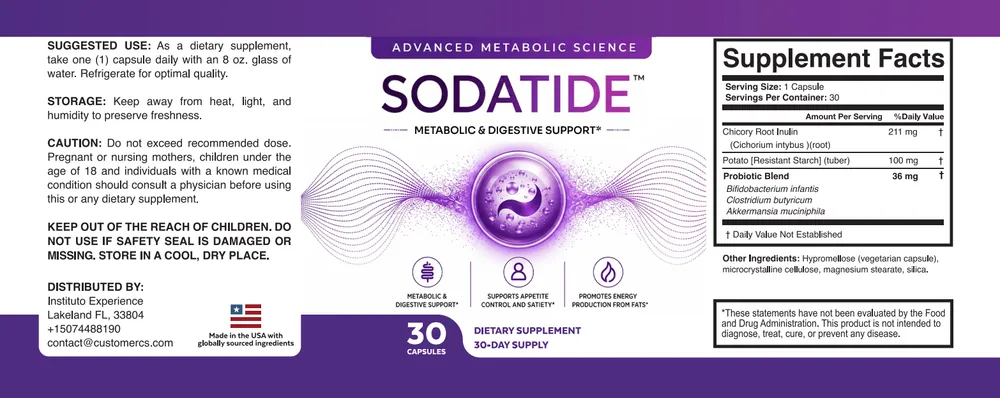
The routine is one capsule a day with water, ideally before breakfast. Chicory root inulin (211 mg) and potato resistant starch (100 mg) are printed with their own dose; a 36 mg probiotic blend carries three named strains — Bifidobacterium infantis, Clostridium butyricum and Akkermansia muciniphila.
Distributed by Instituto Experience and made in the USA, according to the company, in a facility described as FDA-registered and GMP-certified. Sixty days to change your mind, backed by the company's money-back guarantee.
2. Does Sodatide Actually Work?
Can a daily capsule calm bloating that’s stuck around after cutting gluten, lactose and sugar? Yes, when the bacteria that ferment fiber have thinned out, not when the problem is willpower.
You've already done the elimination-diet work, and the bloating came back by evening anyway. That's the part that makes you wonder if your gut is working against you.
The research is specific. A 2024 meta-regression in the American Journal of Clinical Nutrition tied chicory inulin to real weight-management outcomes. A 2026 review in Food & Function found resistant starch supports satiety and gut fermentation. A 2026 randomized trial in Clinical Nutrition found Akkermansia muciniphila changed metabolic and endocrine markers in adults with obesity-linked dysfunction. In plain terms: better fuel, and the right bacteria to ferment it.
Sodatide pairs both in one capsule a day: chicory inulin and resistant starch as the fuel, Akkermansia, Clostridium butyricum and Bifidobacterium infantis as the fermenters. It's a potentializer, not a switch, and the response varies with diet, stress and the gut's own starting point. Many people notice the first shift from week 3. That's why it's worth the try.
3. What Sodatide Does for A Calmer Gut and a Scale That Starts to Move
Sodatide is built for the moment you stop planning your day around how your stomach feels. Not a crisis — just a pattern that's quietly shaped what you wear, what you order, and whether you say yes to plans after dinner.
You know the routine by now. The looser waistband you keep for "bloat days." The water you drink hoping it'll pass. The relief when an evening ends without your stomach announcing itself.
What changes is how much of the day you spend managing it. Less bracing for the afternoon swell, more just living in your body. See how the fiber and the gut strains divide the work.
- The fiber side, covered — so the bacteria have something to ferment
- Three named strains, not a vague blend — so you know what you’re feeding
- No stimulants — nothing here works by speeding anything up
- One capsule a day — nothing to measure, nothing to mix
- Refrigerate and forget — a routine that fits into a morning already in motion
4. Why It Earns 4.5 / 5
Two dosed fibers and a three-strain probiotic blend, led by the chicory inulin and resistant starch pairing that feeds Akkermansia muciniphila, the strain with its own 2026 randomized controlled trial on metabolic and endocrine markers.
What stands out:
- A fermentation pathway with real 2024–2026 research. Chicory inulin, resistant starch and Akkermansia muciniphila each carry recent published research tied to the exact mechanism this formula leans on.
- Akkermansia muciniphila, backed by a randomized controlled trial. The 2026 Clinical Nutrition study measured real change in metabolic and endocrine markers.
- No stimulants. Nothing in the formula works by raising heart rate or adrenaline.
- One capsule a day. No scoop, no dropper, no stacking pills to hit the stated dose.
- Two of the three components carry a printed dose. Chicory inulin and resistant starch are each listed individually.
- Sixty days to decide, backed by the company’s money-back guarantee.
Worth knowing:
- No single-bottle trial size. The smallest package is two bottles, a 60-day supply, so there’s no low-commitment way to sample it first.
- Not carried in stores yet. Sodatide ships from its own checkout page rather than a retail shelf.
- A newer name on the shelf. Sodatide doesn’t yet have years of independent reviews to point to.
5. Who Is Sodatide Best For?
Best match if you:
- Daily bloating has started to feel like the rule, not the exception, even after cutting gluten, lactose and sugar.
- You’d rather feed your gut than restrict it further — named strains and real fiber, not another elimination list.
- You want the fermentation pathway studied, not just a probiotic label — chicory inulin, resistant starch and Akkermansia muciniphila each carry recent published research.
- One capsule fits your morning better than powders, drops or a multi-pill stack.
Daily bloating rarely stays confined to the stomach. It changes what you wear, what you order at a restaurant, and how willing you are to make plans after a meal. Cutting gluten, lactose and sugar was supposed to fix it, and when the bloating stayed anyway, it's easy to wonder if your gut is simply working against you. What actually matters is which bacteria are fermenting what you eat, not another restriction. Judge any gut-focused routine over several weeks, not one day.
6. How It Compares
| Criteria | SodatideYou’re reading it | LeanBiome |
|---|---|---|
 |
 |
|
| Lead pathway | Fiber-fed fermentation, led by Akkermansia muciniphila | Nine-strain probiotic blend |
| Route | Capsule, 1 serving daily | Capsule, 2 servings daily |
| Best for | Daily bloating and a stalled scale after diet changes | Belly fat that outlasted every diet change |
| Guarantee | 60 days, money-back | See the review for its own terms |
| Where to buy | See Product Details → | Manufacturer's Site → |
7. Pricing Options for Sodatide
Let the weeks decide the package, not the price tag. Digestive adjustment shows first, and the fuller fermentation shift builds toward week 6 to 12. Two bottles is sixty days, enough to judge tolerance but not the full window. Three covers that stretch, and six keeps the routine going at the lowest price per bottle.
2 Bottles
60-Day Supply
6 Bottles
180-Day Supply
3 Bottles
90-Day Supply
Every order is backed by a 60-day money-back guarantee from the date of purchase. The company asks for at least 30 days of consistent use before requesting a refund. The official site is the only channel that guarantees an authentic bottle and honors that refund.
The prices above are the package prices the manufacturer is running right now, each tied to a limited number of units. The official page is the only place today’s offer can be confirmed.
8. The Mechanism: Fiber and Bacteria — Why the Fuel Has to Come With the Fermenters
Three gut strains, fed by two kinds of fiber — and the pairing has to run in that order.
The fuel — chicory inulin and potato resistant starch. Both are fibers the small intestine can't fully break down, so they travel to the colon mostly intact, which is where the mechanism actually happens.
The fermenters — Akkermansia muciniphila, Clostridium butyricum and Bifidobacterium infantis. These three named strains ferment that fiber into short-chain fatty acids, led by butyrate.
The signal — butyrate. It's the compound current research ties to appetite and metabolic signaling — the pathway the whole fermentation chain runs through, and the reason the fiber and the bacteria have to be paired rather than taken alone.
Two things on the panel, in plain English
Resistant starch — a starch that resists digestion in the small intestine and reaches the colon mostly intact, where gut bacteria can ferment it. Unripe (green) bananas are a well-known natural source; Sodatide uses a potato-derived version instead.
Short-chain fatty acid (SCFA) — a compound gut bacteria produce when they ferment fiber. Butyrate is the best-studied of the main SCFAs, and current research ties it to gut-barrier health and metabolic signaling.
Full Ingredient List
Two printed doses and a three-strain probiotic blend, each with its own job.
| Ingredient | Pathway | Role in the Formula |
|---|---|---|
| Chicory Root Inulin (Cichorium intybus) — 211 mg | Prebiotic fermentation → appetite signaling | A fermentable fiber that feeds the gut strains below, supplying the raw material the fermentation pathway runs on. |
| Potato Resistant Starch — 100 mg | Gut fermentation → SCFA production | A starch that reaches the colon mostly intact instead of digesting in the small intestine, where it becomes fuel for the same bacteria. |
| Akkermansia Muciniphila — part of the 36 mg probiotic blend | Gut-barrier & metabolic-endocrine | The lead strain in the probiotic blend, most consistently linked to a healthy gut lining and metabolic signaling in current research. |
| Clostridium Butyricum — part of the probiotic blend | Butyrate production | One of the best-known butyrate-producing strains, converting the fermented fiber into the short-chain fatty acid the pathway runs on. |
| Bifidobacterium Infantis — part of the probiotic blend | Gut-flora diversity & barrier support | A well-characterized, early-colonizing Bifidobacterium strain that rounds out the blend's bacterial diversity and supports the same gut-barrier function the other two strains work toward. |
Realistic Week-by-Week Timeline
The routine comes first: one capsule daily, and the fermentation side builds week over week.
| Timeframe | What to Expect | Driven By |
|---|---|---|
| Week 1–2 | The routine settles in: one capsule a day, refrigerated after opening. Chicory inulin and resistant starch begin fermenting in the colon as the gut adjusts to the daily fiber load; some people notice digestive changes before anything else shifts. | Chicory Inulin + Resistant Starch |
| Week 3–6 | As the fed strains multiply, butyrate production ramps up — the window the short-chain-fatty-acid research ties to appetite and endocrine signaling. | Clostridium Butyricum + Bifidobacterium Infantis |
| Week 6–12 | Akkermansia's studied effect on metabolic and endocrine markers builds over this stretch, the window gut-microbiome research generally points to for a real bacterial shift. | Akkermansia Muciniphila |
| Month 3+ | The assessment point for the full formula, and the window the company's own three-bottle package is built around. | Maintenance |
9. Side Effects & Safety
The fibers and bacterial strains here have long histories of dietary and supplement use, and most people take a formula like this without incident. The considerations below are specific to this label rather than generic.
Possible Side Effects
| Possible effect | Likelihood | What to do |
|---|---|---|
| Gas or bloating as the gut adjusts | Common (first 1–2 weeks) | Typical of any fermentable-fiber formula; taking it with food and water usually settles this as the bacteria adjust. |
| Loose stool | Occasional | Resistant starch and inulin can have a mild laxative effect in sensitive people; taking it with a meal usually helps. |
| Mild stomach discomfort on an empty stomach | Occasional | Take with water alongside breakfast rather than on a fully empty stomach, as the label suggests. |
| Interaction with IBS or SIBO | Uncommon | Fermentable fibers can interact with these conditions, which is worth mentioning at your next doctor's visit if you manage one. |
Already on a prescription? Bring the label to your next appointment. It takes a minute and keeps everything in one place.
See the full breakdown of who should check with a doctor first in the pros and cons.
10. Final Verdict
Is Sodatide worth trying for bloating that won't quit and a scale that won't move? Yes, when the gut bacteria that ferment fiber into butyrate have thinned out. Here is how this applies to you. You've already cut gluten, lactose or sugar. The bloating eased for a week, maybe two, and then crept back in by evening anyway. None of that looks like a willpower problem. Together, it reads like a gut-bacteria population with less to work with than it used to have.
That's one thing, not three separate problems. Chicory inulin and potato resistant starch supply the fiber those bacteria need; Akkermansia muciniphila, Clostridium butyricum and Bifidobacterium infantis do the fermenting that turns it into butyrate, the compound tied to appetite and metabolic signaling. Around that core, the formula stays narrow rather than padded — three named strains and two fibers, each with a defined job in the same fermentation chain. That focus is why the mechanism reads as coherent instead of scattered.
These ingredients were studied over windows running from a few weeks up to twelve, and that range is what should decide the package. Two bottles covers sixty days — enough to judge tolerance and catch the early digestive adjustment, not to see the full fermentation pathway at work. Three bottles covers ninety days, clearing the window the Akkermansia research points to. For someone who has already decided this belongs in the routine, six bottles at $49 a bottle is the lowest per-bottle price the company runs. Given all of that, Sodatide earns its 4.5 out of 5: a fermentation pathway with real research behind it, built around fiber and the bacteria that actually use it.
11. Frequently Asked Questions
Does Sodatide really work for weight loss?
Three of its five named ingredients have real published research tied to this exact mechanism. Chicory inulin has a 2024 meta-analysis on weight-management outcomes, resistant starch has a 2026 systematic review on satiety and gut fermentation, and Akkermansia muciniphila has a 2026 randomized trial on metabolic and endocrine markers. No finished-product trial of Sodatide itself exists, which is true of nearly every supplement in this category.
What's in Sodatide, and are the doses disclosed?
Chicory root inulin (211 mg) and potato resistant starch (100 mg) are printed with their own dose, and a 36 mg probiotic blend carries three named strains — Bifidobacterium infantis, Clostridium butyricum and Akkermansia muciniphila.
How long until I notice anything?
Digestive adjustment tends to register first, in the 1-to-2-week range. Butyrate production builds over weeks 3 to 6 as the fed strains multiply, and Akkermansia's metabolic effects build through weeks 6 to 12, the window gut-microbiome research generally points to for a bacterial shift.
Is Sodatide FDA approved?
Supplements aren't 'approved' by the FDA — no dietary supplement is. Sodatide is produced, according to the company, in a facility described as FDA-registered and GMP-certified, which is a claim about where it's made, not a government sign-off on the product.
Can I trust Sodatide?
Yes. The company names all five ingredients, discloses the dose on two of them outright, publishes its manufacturing claims, and backs every order with a 60-day money-back guarantee.
Who should not take Sodatide, and when should I see a doctor?
The label advises against use for anyone under 18, pregnant, nursing, or with a known medical condition without a doctor's sign-off. If you take medication, have a health condition, or are pregnant, check with your doctor before starting any supplement. A change that comes on suddenly or is getting worse quickly is a reason to see a doctor, not to add a supplement.
INGREDIENT TAGS
FORMAT
Research & Transparency
This content is based on publicly available ingredient research, the product’s supplement facts label, and manufacturer disclosures. Our editorial team works independently of the manufacturer. Marketing claims not supported by the product’s own label are not repeated here.
(a) The Effects of Chicory Inulin-Type Fructans Supplementation on Weight Management Outcomes: Systematic Review, Meta-Analysis, and Meta-Regression of Randomized Controlled Trials. American Journal of Clinical Nutrition (2024)
(b) Glucomannan and Resistant Starch in Obesity Management: A Systematic Review of Satiety, Gut Fermentation, and Weight-Related and Metabolic Outcomes. Food & Function (2026)
(c) Adjunctive Akkermansia Muciniphila Postbiotic Supplementation Modulates Metabolic and Endocrine Profiles in Obesity-Associated Polyendocrine Metabolic Ovarian Syndrome: A Randomized Controlled Trial. Clinical Nutrition (2026)
(d) Small Intestinal Compared With Colonic Short-Chain Fatty Acid Delivery Drives Distinct Systemic Concentrations and Endocrine Responses in Humans: A Randomized, Crossover Trial. American Journal of Clinical Nutrition (2026)
About the Author
Luciano Cesar is a contributor at The Supplement Post, supporting the production of evidence-aware supplement reviews and buyer's guides across multiple health categories. His work spans ingredient analysis, formulation assessment and consumer-oriented summaries — what a label discloses, how the stated doses compare with the amounts used in published human research, and whether a formula's design matches what it claims to do. Every review is checked by The Supplement Post editorial team against the standards published in our editorial policy before it goes live.
Disclosure
All content is for informational purposes only and is not a substitute for professional medical advice. Each product reviewed is a dietary supplement, not a prescription drug. Results may vary. This page may contain affiliate links — if you purchase through them, we may earn a small commission at no additional cost to you. Read our Editorial Policy.
People who buy Sodatide also buy
Fast Lean Pro, targets the between-meal cravings and hunger that a gut-focused fiber-and-bacteria formula doesn't address directly