In This Review:
- 1. Product at a Glance
- 2. Nighttime Trips & Urinary Flow After 50: Evidence, Concerns & Trends
- 3. What Prosta Defend Does and Benefits
- 4. Why We Rate It 4.5 / 5
- 5. Who It's Best For
- 6. How It Compares
- 7. Pricing Options
- 8. The Mechanism + Full Ingredient List
- 9. Side Effects & Safety
- 10. Final Verdict
- 11. FAQs
Reviewed by The Supplement Post Editorial Team, Editorial Review
Updated
1. Product at a Glance
| Product | Prosta Defend |
| Category | Men's Health / Prostate, Urinary Flow & Nighttime Comfort / Capsule |
| Format | Capsules — take 2 capsules daily with a meal. 60 capsules per bottle (30 servings, 30-day supply). |
| Key Ingredients | Six botanicals aimed at the prostate and urinary tract: Saw Palmetto, Pygeum Africanum, Stinging Nettle, Red Raspberry, Cat's Claw and Soursop (graviola) |
| Manufacturing | Made in the USA. Retailer of record at checkout is BuyGoods, a Delaware corporation; returns go to an Aurora, Colorado address. Not evaluated by the FDA. Per-ingredient doses are not published on the brand's pages. |
| Guarantee | 90-day money-back |
| Our Rating | 4.5 / 5 |
Quick Verdict
Prosta Defend is aimed at the one prostate symptom men actually lose sleep over — and it is built on the right botanicals to try. Six ingredients, two capsules a day with a meal, positioned around night-time trips to the bathroom rather than vague “prostate health.” The formula’s real strength is pygeum africanum. A Cochrane review of randomized trials found it modestly but significantly improved urologic symptoms and flow — the cleanest positive evidence any botanical has in this category. Stinging nettle has moderate support alongside it. Saw palmetto sits beside it as the traditional base of the category, with red raspberry, cat’s claw and soursop rounding out the formula. Made in the USA, 90-day money-back guarantee (with return conditions worth reading), sold through the brand’s own order page with BuyGoods as retailer of record.
2. Nighttime Trips & Urinary Flow After 50: Evidence, Concerns & Trends
Before the formula itself, here is what the evidence, the common concerns, and the current market actually show about night-time trips and urinary flow after 50. One finding about this brand’s own reference list is worth a minute of your time too.
| The concern / trend | What the evidence shows | What it means for you |
|---|---|---|
| The symptom that costs the most is the one nobody talks about: sleep | Benign prostatic enlargement is close to universal with age — present in around half of men by their sixties and the large majority by their eighties (NIDDK/NIH). Of all its symptoms, night-time urination is consistently rated the most bothersome, because it fragments sleep rather than merely inconveniencing the day. | If what bothers you is waking twice a night rather than the prostate itself, you are measuring the right thing — and it is the outcome this formula is built around. |
| Pygeum has the cleanest positive evidence in the whole category | A Cochrane systematic review of randomized trials concluded that Pygeum africanum modestly but significantly improves urologic symptoms and flow measures, including night-time frequency — while noting the trials were short and varied in design. | This is the ingredient worth being here, and it is in the formula. “Modest but significant” is also the honest size of effect to expect from any botanical. |
| The evidence in this category has moved beyond the one famous name | A Cochrane review of randomized trials found pygeum africanum improved urologic symptoms and flow, and work on specific hexanic extracts (BJU International, 2018) shows the type of preparation is what separates one study from another. | Read past the front of the label. What decides a prostate formula is whether the botanicals with randomized evidence are actually in it — and at amounts that resemble the ones studied. |
Where Prosta Defend fits: the honest middle of the prostate category. It leads with the right symptom, includes the best-evidenced botanical there is for it, and backs the purchase with 90 days. What carries this formula is pygeum, with nettle beside it — the pair European phytotherapy has leaned on the longest. Here is what the formula actually does.
3. What Prosta Defend Does and Benefits
Prosta Defend solves one problem, and it is a sleep problem before it is a prostate problem: waking up at 2 a.m. because your bladder decided the night was over. Two capsules a day with a meal, six botanicals, aimed at flow and night-time frequency rather than at some abstract idea of prostate wellness.
Here is why that framing matters. As men age the prostate gradually enlarges — it is close to universal, present in roughly half of men by their sixties. As it grows, it presses on the urethra and stiffens the bladder’s response. The result is not usually pain. It is friction: a stream that takes a moment to start, a sense of not quite finishing, and a bladder that signals urgency at a fraction of its old capacity. The night-time waking is the part that actually degrades life, because broken sleep touches everything else — energy, patience, focus, mood.
You know the specific version of this. Standing at the toilet waiting for something that used to be immediate. Doing the arithmetic before a long drive about where the stops are. Waking at 2 a.m., then again at 4, and lying there afterwards knowing the alarm is close. Sitting through a film with one eye on the aisle. None of it feels serious enough to raise with a doctor, so most men simply plan around it for years.
Prosta Defend puts pygeum africanum — the botanical with the best randomized evidence for exactly these symptoms — alongside stinging nettle and saw palmetto, the traditional European pairing for urinary flow. Red raspberry, cat’s claw and soursop round out the antioxidant and inflammatory side. Week by week, the reported pattern runs in order. Weeks 1–2: the stream starts more readily. Weeks 3–4: the change men actually notice — one fewer trip in the night. Weeks 6–12: the window the pygeum trials measured, where sleep tends to run in longer blocks again.
What it does not do: shrink an enlarged prostate, replace a prescription, or substitute for a diagnosis. And it cannot tell the difference between benign enlargement and something that needs a doctor. That is why blood in the urine, pain, fever, or an inability to urinate calls for an appointment, not a supplement. Made in the USA, 90-day money-back guarantee. How the six botanicals actually work →
4. Why We Rate It 4.5 / 5
If it is the waking up that is wearing you down, this one is built around the single prostate botanical with clean randomized evidence behind it.
- It targets the symptom that actually matters. Night-time trips and flow, rather than a vague prostate claim — the outcome men can measure for themselves.
- Pygeum africanum is in the formula. The botanical with the cleanest randomized evidence in this entire category, backed by a Cochrane review.
- The classic European pairing is intact. Nettle alongside saw palmetto is the long-standing combination in phytotherapy for urinary symptoms.
- 90-day money-back guarantee. A genuinely long evaluation window, well beyond the 30-day windows common in this category.
- Simple, sustainable routine. Two capsules with a meal, once a day, nothing to time around.
- Sensible per-day cost. $1.63/day on the 6-bottle bundle, below the category average for a multi-botanical prostate formula.
- Some symptoms need a doctor, not a supplement. Blood in the urine, pain, fever or difficulty passing water at all are reasons to get seen — this is for the everyday kind of bother, not for those.
- It is aimed at one thing: the night-time trips and the flow. If what you are after is libido, testosterone or firmness, this is the wrong shelf — look at a male vitality formula instead.
- Check with your doctor if you are already on prostate or blood-pressure medication. Botanicals that work on the same pathways are worth mentioning at your next appointment before you start.
5. Who Is Prosta Defend Best For?
Best match if you:
- Want fewer interruptions at night more than you want a general “prostate” product — that is exactly what this formula is aimed at.
- Prefer the ingredient with real trial evidence over a longer list of names you cannot verify — pygeum is the reason to consider this one.
- Want a genuinely long evaluation window before committing — 90 days covers the period the research actually measures.
- Are past 50 and noticing gradual change in stream and frequency rather than a sudden one.
- Want a simple daily capsule rather than a powder, tincture or timed protocol.
6. How It Compares
These are three legitimate routes to the same outcome — fewer interruptions and easier flow — and which fits depends more on format and on your dominant symptom than on which scores highest. All three are products we rate well.
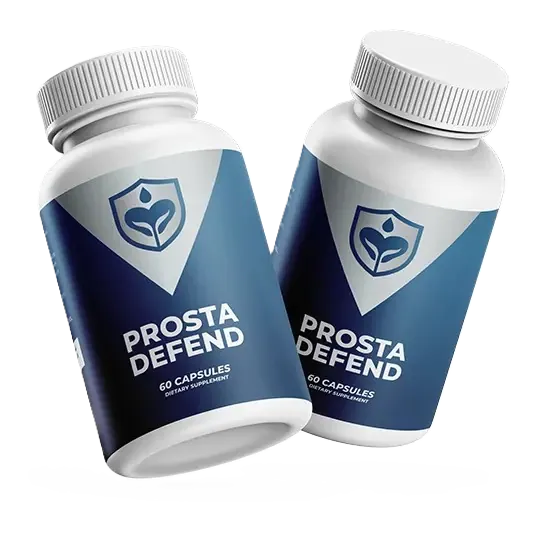
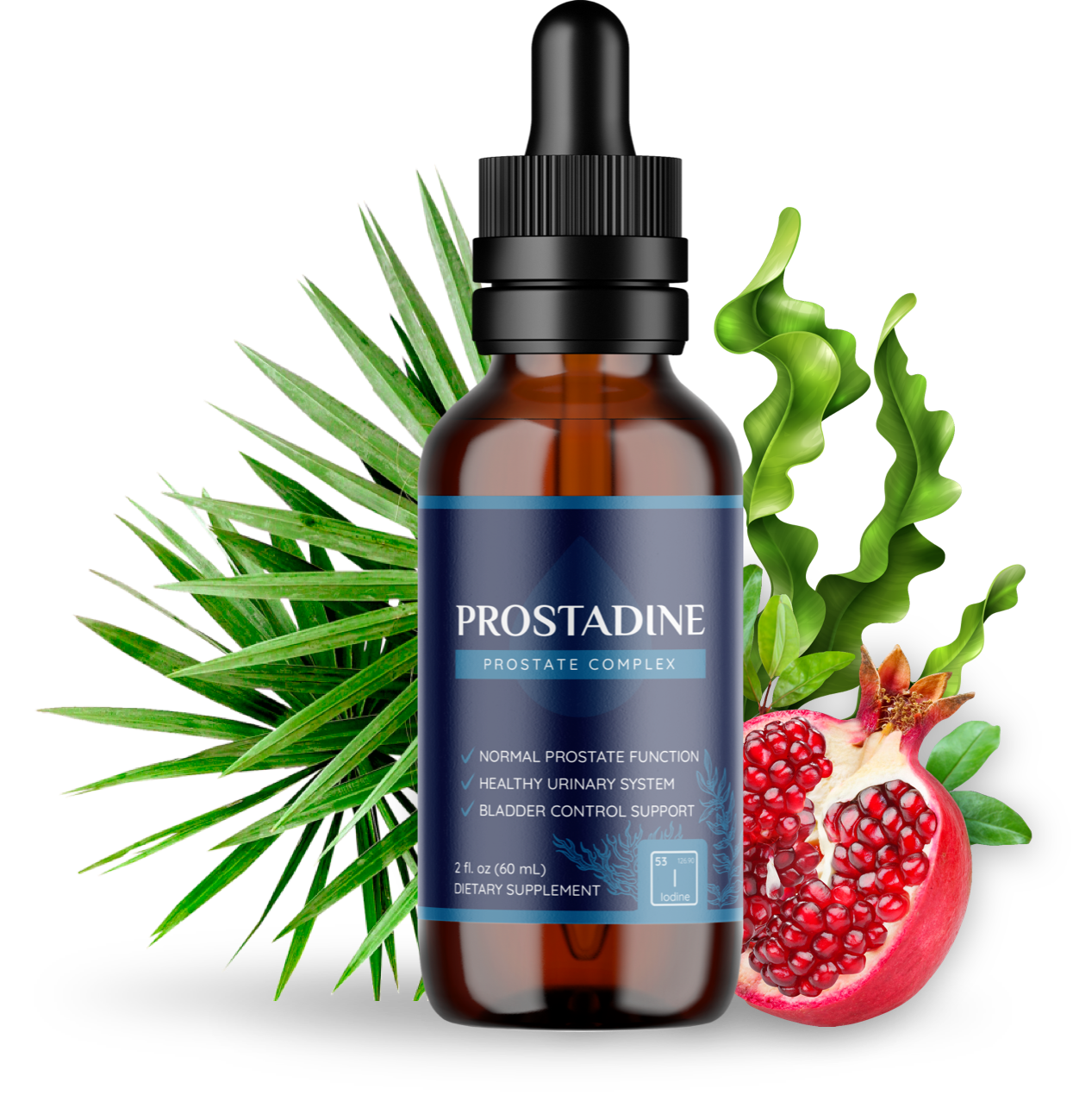
| Criteria | Prosta Defend | Prostadine | TitanFlow |
|---|---|---|---|
 |
 |
 |
|
| Primary focus | Night-time trips and flow | Prostate and urinary flow | Weak stream and incomplete emptying |
| Format | 2 capsules daily | Liquid dropper | Capsules daily |
| Hero ingredient | Pygeum africanum | Iodine and sea-mineral complex | Flow-targeted botanical blend |
| Best price | $49/bottle (6-pack) | See review | See review |
| Best for | Men whose main complaint is waking at night | Men who would rather take drops than capsules | Men whose main complaint is the stream itself |
| Where to buy | Official Site → | Official Site → | Official Site → |
Prostadine is the pick if the capsule routine is what you would abandon — a dropper in the morning is a different kind of habit, and it covers the same urinary territory. TitanFlow is built specifically around stream strength and the feeling of not fully emptying, so if that is your dominant symptom rather than the night-time waking, it is the more targeted choice. Prosta Defend’s distinguishing feature is pygeum plus the 90-day window. None of the three is a runner-up here — they are three sensible tools for different corners of the same problem.
Full reviews: Prostadine · Titanflow Zenith Lab
7. Pricing Options for Prosta Defend
The routine settles early, and some men notice the stream in the first fortnight. The win most are after — one fewer trip in the night — comes at weeks 3 to 4, and the peak window the pygeum trials measured runs weeks 6 to 12. The entry, two bottles, ends before that peak. Three bottles at $59 reaches it. Given all of that, six bottles at $49 each is the one we would take.
2 Bottles
60-Day Supply
- Secure Checkout
6 Bottles
180-Day Supply
- 2 Free Digital Bonuses
- Secure Checkout
3 Bottles
90-Day Supply
- 2 Free Digital Bonuses
- Secure Checkout
Every order is backed by a 90-day money-back guarantee. The official site is the only channel that guarantees an authentic bottle and honors that refund.
8. The Mechanism: Why Six Botanicals, Not One
Prostate formulas tend to fail in one of two ways: they pick a single famous herb and hope, or they list twenty names at amounts too small to matter. This one takes a middle path — a small set of botanicals, three of which have genuine urinary research behind them, and three which are supporting antioxidants.
The evidence anchor — Pygeum Africanum. Extract of the African plum tree, and quietly the most important thing in the bottle. A Cochrane review of randomized controlled trials concluded it modestly but significantly improves urologic symptoms and flow measures, with reported reductions in night-time urination. The proposed mechanism is anti-inflammatory action on prostate tissue plus an effect on bladder contractility — which fits the symptom pattern men describe. The review’s own caveat is fair and we will repeat it: the trials were short and varied in design.
The famous one — Saw Palmetto. Serenoa repens is believed to inhibit 5-alpha-reductase, the enzyme converting testosterone into DHT, which drives prostate growth — the same mechanism finasteride uses, far more weakly. That rationale is why it has been the category’s default for thirty years. Work on specific hexanic extracts (BJU International, 2018) points to the preparation as what separates one result from another — which is why the botanicals beside it on this label matter as much as the saw palmetto line itself.
The traditional partner — Stinging Nettle Root. Rarely studied alone; usually paired with saw palmetto in European phytotherapy, where the combination has moderate evidence for urinary symptoms. It is thought to act on sex-hormone-binding globulin and on prostate tissue directly.
The supporting three — Red Raspberry, Cat’s Claw, Soursop. Here we are candid. Cat’s claw has documented anti-inflammatory activity, which is a plausible rationale given that prostate discomfort has an inflammatory component. Red raspberry contributes polyphenols and soursop antioxidant compounds. None of the three has human prostate trials behind it. They round out the formula; they are not the reason to buy it.
Run together daily, the intended effect is straightforward: calm the inflammatory side, support the hormonal pathway that drives enlargement, and improve how the bladder empties — so the night runs in longer, uninterrupted blocks.
What these terms actually mean:
- BPH (benign prostatic hyperplasia)
- Age-related prostate enlargement. “Benign” is the important word — it is not cancer. The gland sits around the urethra like a ring around a hose, so as it grows it squeezes the flow.
- Nocturia
- Waking in the night to urinate. The clinical name for the symptom that wrecks your sleep, and consistently the one men rate as most bothersome.
- LUTS
- “Lower urinary tract symptoms” — the umbrella term researchers use for the whole cluster: weak stream, hesitancy, urgency, incomplete emptying and night-time waking.
- DHT and 5-alpha-reductase
- DHT is a potent form of testosterone that drives prostate growth; 5-alpha-reductase is the enzyme that makes it. Prescription drugs block that enzyme hard; saw palmetto is proposed to nudge it.
- PSA
- A blood marker your doctor uses to screen the prostate. It matters here because saw palmetto can lower the reading — which is why your doctor needs to know you are taking it.
Full Ingredient List
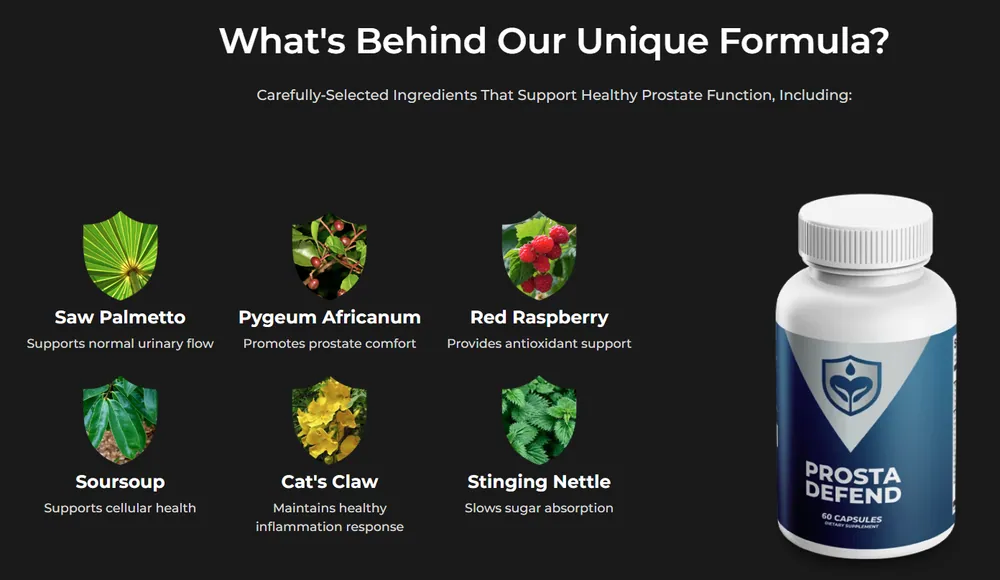
Six botanicals, two capsules daily with a meal. The brand does not publish per-ingredient amounts anywhere on its pages — the graphic above is as specific as the labelling gets. What follows is what each one contributes and, just as importantly, how strong the human evidence behind it actually is.
| Ingredient | Pathway | Role in the Formula |
|---|---|---|
| Pygeum Africanum | Urinary symptoms / Flow | Quietly the strongest thing in the bottle. A Cochrane review of randomized trials concluded pygeum modestly but significantly improves urologic symptoms and flow measures — including reduced nocturia. It is the ingredient here with the cleanest positive evidence. |
| Saw Palmetto (Serenoa repens) | Prostate / LUTS | The category’s most famous botanical, and the traditional base that European phytotherapy has built prostate formulas on for decades. Later work on specific hexanic extracts is more favourable, so extract type appears to matter. |
| Stinging Nettle (Urtica dioica) Root | Prostate / Hormonal | Usually studied alongside saw palmetto rather than alone. The evidence is moderate and the pairing is a long-standing one in European phytotherapy for urinary symptoms. |
| Red Raspberry | Antioxidant | Polyphenol and antioxidant support. Honest framing: there is no prostate-specific human trial evidence behind it — it is a general wellness ingredient in this formula. |
| Cat’s Claw (Uncaria tomentosa) | Inflammatory response | Has documented anti-inflammatory activity in the literature, which is a plausible rationale for prostate comfort — but that research is general, not prostate-specific. |
| Soursop / Graviola | Cellular / Antioxidant | The formula’s most speculative inclusion. Studied for antioxidant and cellular activity in general, with no human prostate trials supporting it here. |
Realistic Week-by-Week Timeline
The first change tends to arrive sooner than the research window suggests, and it is a small one: the stream starting more readily within a week or two. The gain most men are actually after — a night with one fewer interruption — usually follows in weeks three to four.
| Timeframe | What to Expect | Driven By |
|---|---|---|
| Week 1-2 | Early and easy: the routine settles into a meal, and some men notice the stream starting a little more readily than it did. | Getting consistent |
| Week 3-4 | The win most men are actually after — one fewer trip in the night, and sleep that finally runs in longer blocks. | Pygeum + saw palmetto + nettle |
| Week 6-12 | Peak window. This is the range in which the pygeum trials measured symptom and flow improvement, and where men report feeling comfortable being away from a bathroom again. | Full botanical effect |
| Month 3+ | Gains hold with continued daily use. | Maintenance |
9. Side Effects & Safety
These are widely used botanicals with long safety records, and Prosta Defend is generally well tolerated. The realistic considerations are interactions and one screening issue that genuinely matters — and which most reviews of prostate supplements never mention.
| Possible effect | Likely cause | What to do |
|---|---|---|
| Mild stomach upset or nausea | Saw palmetto and pygeum on an empty stomach — the most commonly reported issue with both | Take the two capsules with a meal, which is the brand’s own instruction and usually resolves it. |
| A lower PSA reading at your next test | Saw palmetto can suppress PSA | Tell your doctor you are taking it before any PSA test. A falsely reassuring reading can delay detection of something that needs finding. |
| Headache or mild dizziness | Individual response, usually early | Typically settles within the first week or two. Stay hydrated. |
| Easier bruising | Saw palmetto has a mild antiplatelet effect | Relevant mainly if you take a blood thinner or have surgery scheduled — worth a conversation with your doctor. |
| No change at all after 3–4 weeks | Too early, or the cause is not the one this addresses | Give it the full 6–12 weeks. If nothing has shifted by then, the guarantee exists for that reason — and a urology appointment is the better next step. |
Worth a word with your doctor if you:
- You are due a PSA test, or you have one on record. This is the most important item here. Saw palmetto can lower PSA readings, so your doctor needs to know before interpreting a result.
- You already take finasteride, dutasteride, or an alpha-blocker (tamsulosin, alfuzosin) for your prostate. Overlapping mechanisms should be a medical decision, not a self-directed stack.
- You take a blood thinner or have surgery scheduled — saw palmetto has a mild antiplatelet effect.
- You have blood in your urine, pain on urination, fever, or cannot urinate at all. None of these is a supplement situation; get seen promptly.
- Your symptoms appeared suddenly rather than creeping up over years. A sudden change deserves investigation before you self-treat.
- Not intended for women or for anyone under 18. Not evaluated by the FDA, and not intended to diagnose, treat, cure or prevent any disease.
If none of that applies to you, there is no medical reason to hesitate — for most healthy adults this is well tolerated at the labeled dose.
10. Final Verdict
The aisle seat at the cinema, chosen on purpose, every time. Prosta Defend does the thing the advertising does not: it picks the right target and includes the right ingredient. The target is night-time waking and flow — the symptoms that genuinely erode life after 50. The ingredient is pygeum africanum, which a Cochrane review of randomized trials found modestly but significantly improves urologic symptoms and flow measures. In a category where most products lead with saw palmetto and hope you do not check the research, leading with pygeum is the more defensible choice.
We have been equally clear about the limits, because that is what makes the rest trustworthy. The evidence here concentrates in pygeum and nettle, which is where the randomized research in this category actually sits. What is solid is the commercial side — made in the USA, a 90-day money-back guarantee, and a per-day cost below the category average.
Our recommendation — and the honest package math. These botanicals were studied over a 6-to-12-week window, and that timeline is what should decide the package. The 2-bottle option is sixty days at $79 a bottle plus shipping, with no bonuses: the most expensive way to buy it, and it ends right as that window opens. The 3-bottle bundle at $59/bottle ($177) is the minimum for a fair trial — ninety days, free shipping, both bonuses. Given all of that, the 6-bottle bundle at $49/bottle ($294) is the one we would choose: the lowest price per bottle, and six months of continuity so you are not re-ordering mid-improvement. Two capsules daily with a meal, and judge it at week eight rather than week two.
11. Frequently Asked Questions
Does Prosta Defend really work?
The honest answer depends on which ingredient you weigh. Pygeum africanum is the strongest card in the deck — a Cochrane review of randomized trials found it modestly but significantly improved urologic symptoms and flow, including night-time frequency. Stinging nettle has moderate support. Saw palmetto is the familiar one, and the base most formulas in this category start from. That negative result is carried into the 2026 systematic review in Drugs in Context. So: a reasonable expectation is fewer nighttime interruptions and easier flow over 6–12 weeks — not a cure for an enlarged prostate, and not a substitute for seeing a doctor.
What are the ingredients in Prosta Defend?
Six botanicals: Saw Palmetto, Pygeum Africanum, Stinging Nettle, Red Raspberry, Cat’s Claw and Soursop (graviola), in a 60-capsule bottle taken two per day with a meal. The brand does not publish per-ingredient doses on its pages, so the amounts cannot be checked against the research — something to know going in, though it is common in this category.
How long does Prosta Defend take to work?
Most men should judge it at 6 to 12 weeks, which is the window the pygeum trials used. The change usually reported first is one fewer trip in the night somewhere around weeks three to four. Two capsules daily with a meal, consistently, is the routine to give it a fair test.
Is Prosta Defend safe? Any side effects?
These are widely used botanicals and are generally well tolerated; mild digestive upset is the most commonly reported issue and taking the capsules with food usually settles it. Talk to your doctor first if you take a blood thinner, a blood-pressure medication, or finasteride/dutasteride or an alpha-blocker for your prostate. Most importantly: saw palmetto can lower PSA readings, so tell your doctor you are taking it before any PSA test.
Is Prosta Defend the same product sold on Amazon and Walmart?
Not necessarily — and this matters. A different “Prosta Defend” from another distributor circulates on marketplaces with a completely different formula (a proprietary blend with nettle, saw palmetto, tribulus and oat straw, plus vitamins C, D3 and B6). The product reviewed here is the six-botanical formula sold through the brand’s own order page. Same name, different products — see our where-to-buy breakdown for the side-by-side.
Where can I buy Prosta Defend?
Through the brand’s official order page, which is also the only route where the 90-day guarantee applies. Note that BuyGoods — not “Prosta Defend” — is the retailer of record and is what will appear on your card statement. That is the brand’s disclosed checkout structure, not an unauthorised charge.
INGREDIENT TAGS
FORMAT
Research & Transparency
This content is based on publicly available ingredient research, the product’s published ingredient list, and manufacturer disclosures. We are not affiliated with the manufacturer. Marketing claims not supported by the product’s own label are not repeated here.
(a) Urtica dioica root extract in patients with benign prostatic hyperplasia — randomized controlled trial. Pakistan Journal of Biological Sciences 2020
(b) Serenoa repens for lower urinary tract symptoms due to benign prostatic hyperplasia. Investigative and Clinical Urology 2021
(c) Efficacy and safety of Serenoa repens in benign prostatic disorders — systematic review. Drugs in Context 2026
(d) Role of phytotherapy in the management of benign prostatic hyperplasia — summary of the literature. Journal of Clinical Medicine 2023
(e) Enlarged prostate (BPH) — the reference we use for how common it is and what the symptoms actually are. MedlinePlus / NIH
(f) Saw palmetto: usefulness and safety — the agency read on the herb, including what it does not establish. NIH / NCCIH
About the Author
Luciano Andreoti is a contributor at The Supplement Post, supporting the production of evidence-aware supplement reviews and buyer's guides across multiple health categories. His work spans ingredient analysis, formulation assessment and consumer-oriented summaries — what a label discloses, how the stated doses compare with the amounts used in published human research, and whether a formula's design matches what it claims to do. Every review is checked by The Supplement Post editorial team against the standards published in our editorial policy before it goes live.
Disclosure
All content is for informational purposes only and is not a substitute for professional medical advice. Each product reviewed is a dietary supplement, not a prescription drug. Results may vary. This page may contain affiliate links — if you purchase through them, we may earn a small commission at no additional cost to you. Read our Editorial Policy.