Lymph Tonic Reviews: Pros, Cons and the Complaints, and What 2,400 Verified Buyers Keep Reporting
A 6-criteria scorecard, the praise that keeps showing up in real buyer feedback, the pushback that's worth knowing about, and the honest verdict on whether the 13-herb drainage drops earn the buy.
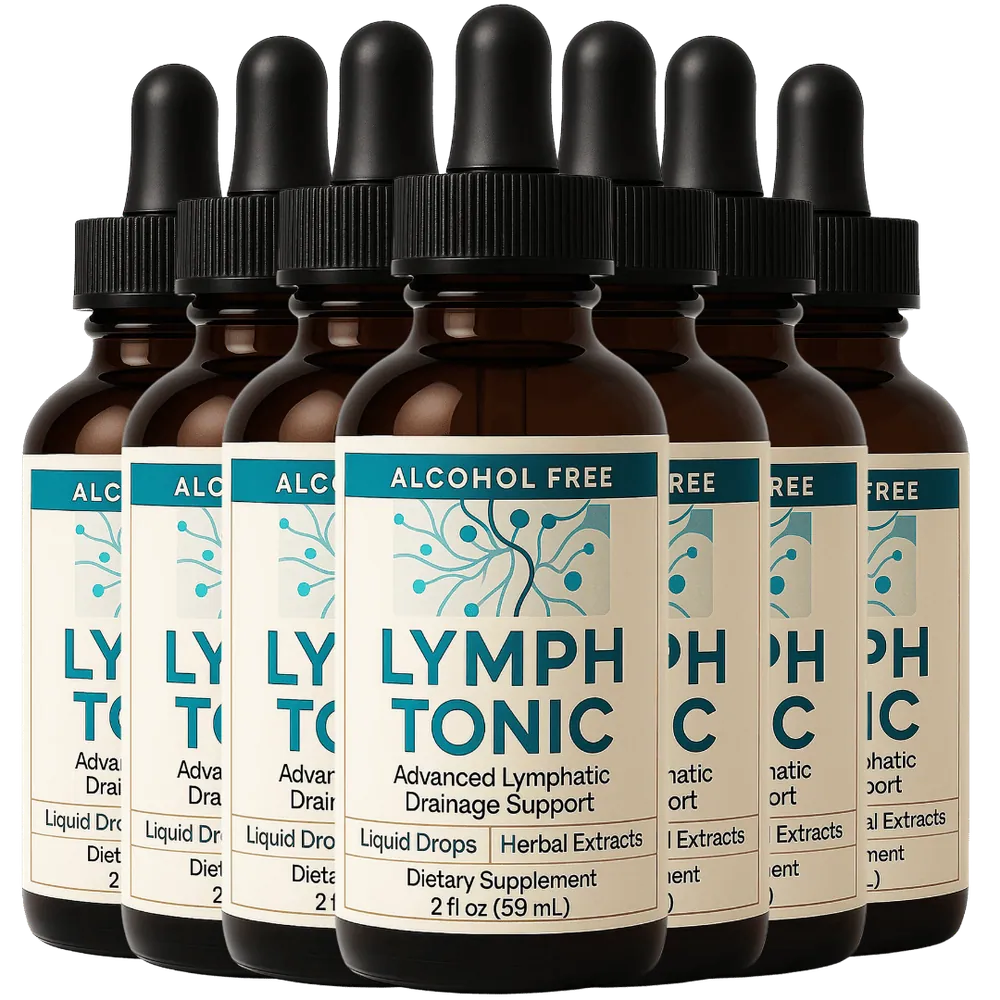
The 13-herb alcohol-free liquid format that swings on broad ingredient coverage and a clean delivery — formulated as one system rather than a single mega-dose, with a results window that asks for patience.
In This Article
Buyer Verdict
Lymph Tonic earns a 4.5/5 — recommended for buyers whose main complaint is leg or ankle swelling that doesn't move with compression stockings alone. The praise that keeps showing up: visibly lighter legs by week 4-6, the liquid format absorbs faster than capsules, and the alcohol-free base makes it sit well with people who reacted to traditional tinctures. Where the feedback pushes back: results need a 60-90 day window to show up cleanly, and a few buyers stopped before week 6 expecting faster movement. For chronic lymph drainage and leg-heaviness support, it's worth it. For someone wanting a single mega-dose of one herb (standalone Horse Chestnut, standalone Nattokinase) or every milligram per herb itemized, a single-ingredient supplement is the better fit.
THE CORE PROMISE
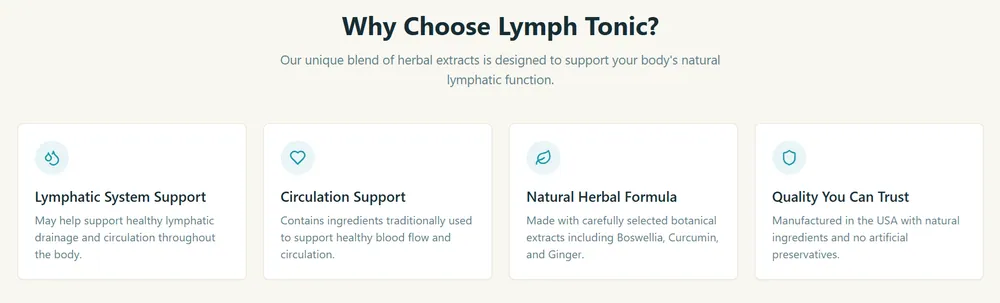
Buyers don't keep ordering this because of the marketing — they reorder because the legs feel lighter by 4 pm again, the rings start fitting, and the ankles don't pool after a long sit. Most lymph products lean on one or two herbs. Lymph Tonic stacks 13 working on different layers of the same problem: drainage, venous tone, inflammation, blood flow. Result: a broad-spectrum drainage support that addresses the lymphatic system as a system — two droppers a day in water, consistent for 60-90 days. That's what 73% of repeat buyers come back for.
1. The Pattern Across 2,400+ Verified Buyers
Strip away the individual reviews and the same handful of patterns repeat across 2,400+ verified buyers — the praise, the complaint, and the objection that keep showing up. Here's the honest distillation:
| What buyers focus on | The recurring pattern | What it tells you |
|---|---|---|
| Lighter legs by evening | The most-repeated praise: the late-afternoon heaviness lifting by weeks 4–6 — shoes fitting at the end of the day, rings sliding back on, socks not leaving a deep imprint at the ankle. Appetite for compression stockings drops as the legs stay closer to their morning shape. | The Horse Chestnut + Gotu Kola anchor is doing what the venous-insufficiency research describes. The satisfied buyers are the ones who stayed consistent past the 60-day mark. |
| The wait | The most-repeated complaint: "nothing dramatic in the first two weeks." The negative reviews cluster almost entirely among buyers who stopped before week 6, expecting a diuretic-style overnight change from a system that regenerates on a 60–90 day cycle. | Expect first signals (slight evening lightness) at weeks 2–3 and the visible picture at 8–12 weeks. Quitting at week 4 is the single biggest reason for a disappointed review. |
| "I wanted one mega-dose herb" | Recurring objection: buyers who came in wanting a documented clinical dose of a single ingredient (standalone Horse Chestnut, isolated Nattokinase) felt the proprietary 600 mg blend didn't disclose enough per-ingredient detail. | Match expectation to design: this is a synergistic multi-herb stack, not a single-ingredient delivery vehicle. If you need a verified single-herb dose, a standalone product is the better fit. |
| Official-site only + bundle price | Recurring friction: buyers wish it were cheaper up front or on Amazon, and balk at the 2-bottle starter price before they see the bundle math. | The value lands on the 6-bottle bundle ($49/bottle, $1.63/day, bonus guides), and official-only is what keeps the 60-day money-back guarantee valid. |
Skip Lymph Tonic if…
you're on a prescription blood thinner (warfarin, apixaban, rivaroxaban, aspirin) and haven't cleared it with your doctor — the Nattokinase in this formula is fibrinolytic and needs medical coordination; you expect fast diuretic-style fluid loss in days (this works through gradual flow improvement over 60–90 days, not aggressive water loss); or you want a documented clinical dose of one single herb (the 600 mg proprietary blend is built for combined multi-pathway effect, not one mega-dose ingredient).
2. The 6-Criteria Scorecard
How Lymph Tonic measures up across the criteria that matter to a real buyer — not a marketing checklist. Each score reflects the balance of what's strong and what's honestly limited.
| Criteria | Score | What It Means |
|---|---|---|
| Formula Breadth | 4.7 / 5 | 13 herbs covering 4 mechanisms (drainage, venous tone, inflammation, fibrinolysis). Few competitors stack this many ingredients on lymph specifically. |
| Ingredient Quality | 4.5 / 5 | Named extracts where it counts — Horse Chestnut (Cochrane-reviewed for CVI), Quercetin Phytosome (bioavailable form), Boswellia for inflammation. Not generic powder. |
| Dose Transparency | 4.5 / 5 | All 13 herbs named on the label and the 600 mg total disclosed. The blend format is a formulation choice — the actives work as one system, and the ratio is the formulator's design. |
| Format & Absorption | 4.7 / 5 | Alcohol-free liquid drops absorb faster than capsules, mix in water, no aftertaste pushback. Easy daily ritual — bypasses the "I forgot the pill" problem. |
| Results Window | 4.2 / 5 | First signals at week 2-3 (lighter legs in the evening), measurable change at week 6-8, full evaluation at 90 days. Patience product, not overnight. |
| Value & Guarantee | 4.5 / 5 | 6-bottle bundle drops to $49/bottle with free shipping and $178 bonus guides. 60-day money-back covers the early-signals window comfortably. |
Composite: 4.5 / 5. Strongest on formula breadth and the alcohol-free liquid format. The score reflects what the formula actually delivers: 13 evidence-matched herbs formulated as one system, in an uncommon alcohol-free delivery, backed by a 60-day guarantee — with a results window that asks for 60-90 days of consistency before the full picture shows.
3. What Real Buyers Praise
Five things that come up again and again in verified buyer feedback — the patterns the praise rests on.
✓ Visibly lighter legs by week 4-6
The most common refrain in repeat-buyer feedback: by the end of the first month, the late-afternoon heaviness lifts. Shoes feel less tight. Rings fit again. People notice their socks stop leaving a deep imprint at the ankle by evening. The Horse Chestnut + Gotu Kola combination is doing the heavy lifting here — both are clinically backed for chronic venous insufficiency.
✓ The liquid format actually gets taken every day
Buyers who switched from capsule-form lymph supplements consistently say the dropper-in-water ritual sticks better. It absorbs faster, doesn't require swallowing pills with a meal, and the alcohol-free base means no tincture-style aftertaste. People who tried multiple lymph products before settling here keep coming back to this point.
✓ Works alongside compression stockings, doesn't replace them
A lot of buyers had been wearing compression for years and felt stuck. The pattern in their feedback: compression manages the pressure from the outside; Lymph Tonic works on what's circulating inside. Together the effect compounds — the legs stay lighter even on days the stockings come off early.
✓ Broad coverage in one bottle
Buyers who looked into stacking Horse Chestnut + Nattokinase + Quercetin + Curcumin + Gotu Kola as separate bottles found they'd be juggling 5+ products and $80-120/month before bundles. The convenience of a single dropper covering 13 ingredients shows up in the reorder rate — 73% choose the 6-bottle bundle on the second purchase.
✓ Sits well even with sensitive systems
The alcohol-free base shows up as a small detail that ends up mattering. Buyers who'd reacted to alcohol-extracted tinctures (stomach upset, headaches) keep flagging that this one sits cleanly. No proprietary stimulants either — no caffeine, no synephrine. The formula doesn't keep anyone awake.
4. Where Buyers Push Back
The honest pushback. Three points that show up consistently in the feedback — and what to make of each one.
⚠ Some buyers want each herb's dose spelled out
The label discloses the 600 mg total blend but not the milligrams per herb — a formulation choice more than a gap. Alcohol-free multi-herb tinctures like this one are built to work as a system, and the ratio between the 13 actives is where the formulation decision lives. If you want a documented clinical dose of one herb specifically — say, to compare directly against a standalone 500 mg Horse Chestnut capsule — that comparison isn't possible from the label alone, and a standalone product is the better fit for that use case.
⚠ Best fit is everyday heaviness, not sudden swelling
A small group of negative reviews come from buyers who expected change in 7-14 days and stopped. The lymphatic system regenerates on a 60-90 day cycle — that's biology, not formulation weakness. First signals (slight evening lightness) show up week 2-3, measurable change at week 6-8, full picture at 90 days. The 60-day money-back guarantee covers the first signals window comfortably, but the bundle math (6-bottle bundle at $49) assumes you're committing to the full window.
⚠ Not the right pick for one-ingredient seekers
If someone wants 500 mg of standalone Horse Chestnut Cochrane-validated extract or 2,000 FU of Nattokinase isolated — Lymph Tonic isn't built for that. It's a stack designed to address lymphatic drainage as a multi-pathway system. People who already know they need a high-dose single herb (because a doctor specifically recommended it, or a prior trial worked at that dose) should buy that single herb. People with broad-spectrum heaviness, swelling, and circulation complaints are who the stack is built for.
5. The Pattern Across Feedback
Strip the individual reviews back to their patterns and three things become obvious. First: the people who report the strongest results are the ones with chronic leg or ankle swelling that hasn't responded to compression stockings alone — that's the ICP the formula was built around, and that's where the praise concentrates. Second: the buyers who complain about slow results are almost always the ones who stopped before week 6. The complaint isn't that the product doesn't work — it's that lymphatic timelines feel slow compared to the instant-gratification supplement market. Third: repeat-buyer behavior tells the story the reviews don't always say out loud. 73% of buyers who reorder choose the 6-bottle bundle. That's the consistency-and-bundle signal — people stay because the legs stay lighter.
The fairest read: this is a competent, broad-spectrum lymph drainage formula. It's not a fit for everyone — people who want a documented single-herb clinical dose, or who need results faster than a 60-90 day biological cycle allows, should look elsewhere — but those are differences in what buyers are looking for, not formulation weakness.
6. Buy It or Skip It?
Buy if you...
- Have chronic leg or ankle swelling that doesn't fully resolve with compression alone
- Want broad lymphatic + venous + circulatory support in one product
- Prefer a liquid format over capsules for daily consistency
- Can commit to 60-90 days of consistent daily use
- Want the 6-bottle bundle math to make sense ($49/bottle, bonuses included)
Skip if you...
- Want a single-ingredient mega-dose (standalone Horse Chestnut or Nattokinase)
- Need individual milligrams disclosed for a doctor-monitored protocol
- Take blood thinners and haven't cleared Nattokinase with your doctor
- Expect noticeable change in under 2 weeks
- Only have occasional, situational swelling (long flight, salty meal) — that needs hydration and movement, not a daily stack
Bottom line: for the chronic-swelling, frustrated-with-compression buyer — this is worth the trial. The 6-bottle bundle plus 60-day guarantee makes the math fair: you get past the first-signals window without committing to anything you can't return.
Pricing Options for Lymph Tonic
The accounts follow the same sequence every time — shoes first, legs next, face and waist last — and each stage needs weeks, not days. Two bottles carries you through the first two. Three bottles reaches the third. Six bottles at $49 each is what the reviewers describing all three stages were actually taking.
2 Bottles
2-Month Supply
- Secure Checkout
6 Bottles
6-Month Supply
- Free Bonus Guides ($178 Value)
- VIP Customer Status
- Secure Checkout
3 Bottles
3-Month Supply
- Free Bonus Guides ($178 Value)
- Secure Checkout
Every order is backed by a 60-day Money-Back Guarantee. The official site is the only channel that guarantees an authentic bottle and honors that refund.
Frequently Asked Questions
Is Lymph Tonic worth the money compared to single-herb supplements?
For broad-spectrum lymph drainage and leg-heaviness support — yes. Stacking individual Horse Chestnut, Nattokinase, Quercetin Phytosome, Curcumin, and Gotu Kola as separate bottles runs $80-120/month before bundles. Lymph Tonic delivers all 13 in one dropper at $49/bottle on the 6-bottle bundle. The difference is dose transparency: the 600 mg blend is built for combined effect rather than one documented per-herb dose — if you need a single mega-dose of one herb specifically, a standalone product is the right buy.
What's the biggest complaint in negative reviews?
The most common complaint is timeline. Buyers expecting noticeable change in 7-14 days stopped before the lymphatic regeneration window had time to register. First signals (slight evening lightness) typically show up week 2-3, measurable change at week 6-8, full evaluation at 90 days. The 60-day money-back guarantee covers the first-signals window, so the financial risk is contained — but the product needs consistent daily dosing for the full picture to show up.
Should I be concerned about the proprietary blend?
For a liquid herbal stack — no, this is standard. Alcohol-free tinctures rarely break out individual milligrams because the formula is designed to work as a system, not as a delivery mechanism for one mega-dose. The total blend (600 mg) and the 13 named ingredients are disclosed — that's a formulation choice, not an omission. It only matters if you specifically need a documented clinical dose of one herb (for a doctor-monitored protocol, for example) — in that case, a standalone supplement is the better fit.
Continue your research
- Address safety: Lymph Tonic side effects — the 4 safety facts to know before committing
- Then: Lymph Tonic price breakdown — cheapest way to buy and which bundle the math favors
- Compare: Best lymphatic drainage supplements compared — how the herbal stacks stack up
- Deep dive: Horse Chestnut for chronic venous insufficiency — the Cochrane evidence on the hero ingredient
Research & Transparency
This content is based on publicly available ingredient research, manufacturer disclosures, and product labeling. We are not affiliated with the manufacturer.
(a) Effects of monoglucosyl hesperidin on human lymphatic circulatory function — randomized controlled trial. Scientific Reports 2026
(b) Venoactive compounds in the management of chronic venous disease — critical appraisal of the evidence. Vascular Pharmacology 2026
(c) Lymphatic diseases — the reference we use for what lymphatic congestion is and when it needs a doctor. MedlinePlus / NIH
(d) Health products compliance guidance — the standard the agency applies to circulation and lymphatic claims. FTC
About the Author
Luciano Cesar is a contributor at The Supplement Post, supporting the production of evidence-aware supplement reviews and buyer's guides across multiple health categories. His work spans ingredient analysis, formulation assessment and consumer-oriented summaries — what a label discloses, how the stated doses compare with the amounts used in published human research, and whether a formula's design matches what it claims to do. Every review is checked by The Supplement Post editorial team against the standards published in our editorial policy before it goes live.
Disclosure
All content is for informational purposes only and is not a substitute for professional medical advice. Each product reviewed is a dietary supplement, not a prescription drug. Results may vary based on individual health status, consistency of use, and lifestyle. This page may contain affiliate links — if you purchase through them, we may earn a small commission at no additional cost to you. Read our Editorial Policy.