In This Review:
- 1. Product at a Glance
- 2. Thinning Hair, Widening Parts and Postpartum Shedding: Evidence, Concerns & Trends
- 3. What Crowned Does and Benefits
- 4. Why We Rate It 4.5 / 5
- 5. Who It's Best For
- 6. How It Compares
- 7. Pricing Options
- 8. The Mechanism + Full Ingredient List
- 9. Side Effects & Safety
- 10. Final Verdict
- 11. FAQs
Edited by The Supplement Post Editorial Team, Editorial Review
Updated
1. Product at a Glance
| Product | Crowned |
| Category | Skin, Hair & Anti-Aging / Hair Density & Scalp Care / Leave-In Peptide Serum |
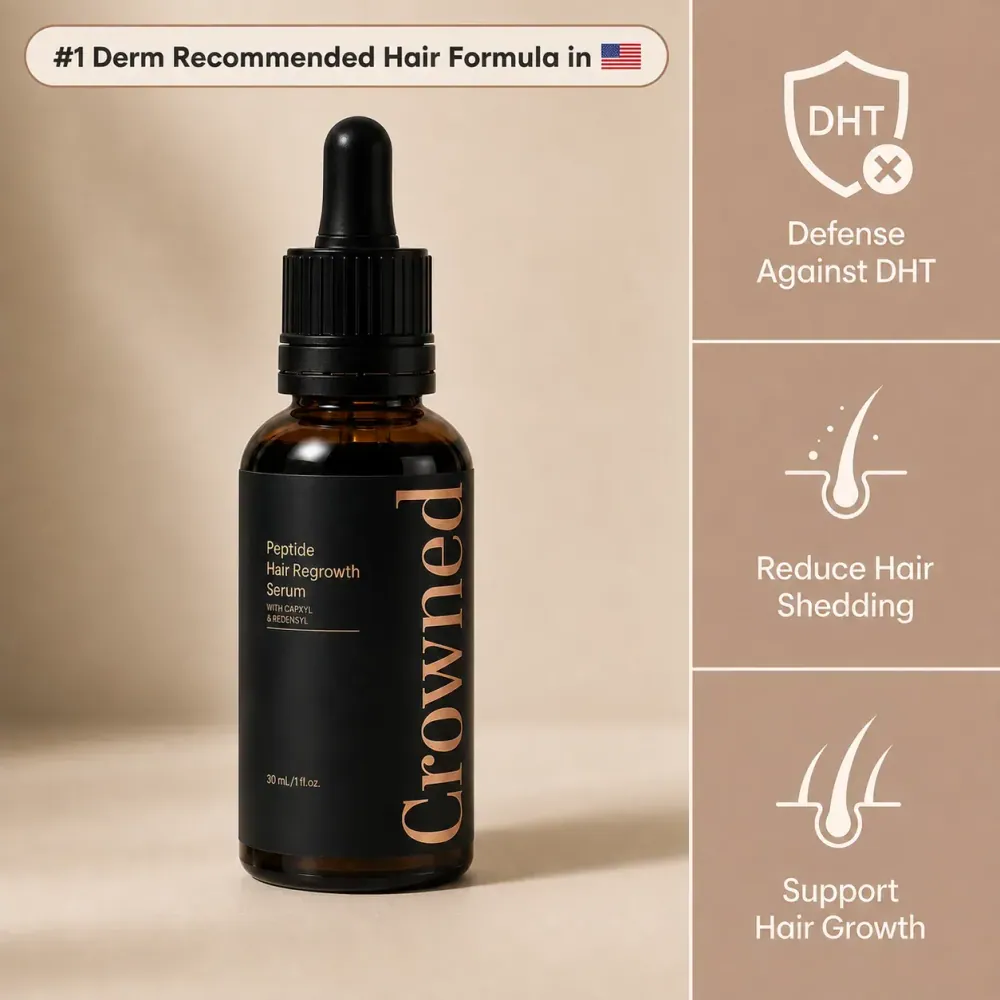
| Format | Leave-in liquid scalp serum — a dropper bottle applied directly to thinning areas once daily and left in, not rinsed out. |
| Key Ingredients | Copper Tripeptide-1 (GHK-Cu), Niacinamide (Vitamin B3), Panthenol (Vitamin B5), and Super Biotin at 4,000 mcg with zinc and silica |
| Manufacturing | Made in the USA in an FDA-registered, GMP-certified facility, according to the manufacturer. Drug-free, sulfate-free, paraben-free, hormone-free and cruelty-free, with no added fragrance or artificial dye. |
| Guarantee | 90-day money-back |
| Our Rating | 4.5 / 5 |
Quick Verdict
Crowned is a leave-in scalp serum built around Copper Tripeptide-1 (GHK-Cu), and it targets a specific problem: hair that is thinning at the root, not just breaking at the ends. A widening part, a ponytail that takes an extra wrap of the elastic, more strands in the drain than there used to be. Most of what is sold for this either rinses off before it reaches the scalp or gets swallowed and never gets there at all.
Crowned pairs GHK-Cu with niacinamide, panthenol and 4,000 mcg of biotin in one dropper, applied to dry or towel-dried scalp once a day and left in. No rinsing, no minoxidil, no hormones. The manufacturer's own timeline is realistic rather than dramatic: less shedding in the first two to four weeks, fine baby hairs by weeks four to eight, visible density over the following months.
The evidence is real but early. GHK-Cu has decades of skincare research behind it for wound healing and collagen support — the same tissue-regeneration signal a manufacturer would want pointed at a scalp that has slowed down. What does not exist yet is a finished-product clinical trial on Crowned itself, or on GHK-Cu applied to hair specifically; a 2025 pharmaceutical review notes that clinical trials on the molecule remain sparse even for its best-established skin uses. What is unusual here is the guarantee: a full 90 days, with no return required, which matches the window the manufacturer's own timeline actually needs to play out.
2. Thinning Hair, Widening Parts and Postpartum Shedding: Evidence, Concerns & Trends
Before the formula itself, three things worth knowing about thinning hair after 40, after pregnancy, or after a hormonal shift — what the evidence actually shows, what the alternatives cost, and the one kind of hair loss a serum was never built to fix.
| What people wonder | What the evidence shows | What it means for you |
|---|---|---|
| “Is female hair thinning actually common, or is it just me?” | It is common. The National Institutes of Health describes female pattern hair loss as a common, recognized form of thinning driven by genetics, hormonal shifts and aging — a documented pattern, not a personal failure. | The part widening or the ponytail thinning is a known pattern with a known biological cause, not evidence you did something wrong. |
| “Does the copper peptide in this actually do anything for hair?” | GHK-Cu is well studied as a general tissue-regeneration and wound-healing signal, but a 2025 pharmaceutical review notes that clinical trials on the molecule remain sparse even for its best-established skin uses — and there is no trial testing it specifically for hair growth. | Real, decades-deep peptide science and a plausible mechanism for why it is applied to the scalp — but not proof of hair regrowth, and not a finished-product trial on Crowned itself. |
| “I already tried postpartum hair vitamins and shampoos.” | Postpartum shedding (telogen effluvium) is a recognized, usually self-limiting pattern tied to the hormone drop after delivery, and a 2023 dermatology review notes it typically improves without intervention — though it flags that shedding persisting well past the expected window is worth a doctor's look. Oral biotin only helps when someone is genuinely deficient, and rinse-off shampoos never reach the follicle in the first place. | A leave-in serum applied to the scalp is at least reaching the right location — but a normal postpartum cycle will also improve on its own, so treat any serum as support, not the sole reason it gets better. |
So where does Crowned sit? On the honest end of a category full of overpromising. It does not claim to cure androgenetic alopecia, does not contain a drug, and does not hide behind a "clinical strength" label with no study attached. What it offers is a leave-in delivery format aimed at the scalp, four named actives with a real (if early) evidence trail, and a 90-day guarantee that gives the manufacturer's own timeline room to actually play out. Here is what the formula does.
3. What Crowned Does and Benefits
Crowned is built for one specific gap: the widening part and the thinning ponytail that most hair products never actually reach. Not split ends. Not dull strands. The root.
Here is the piece that explains the rest, and most hair products skip it. A hair follicle does not simply die when hair thins — it can shrink and slow down while staying alive, spending less time in its active growth phase and more time dormant. That shift is driven by hormonal changes (pregnancy, perimenopause, plain aging) that alter the environment right around the root. Nothing rinsed off in the shower or swallowed as a gummy ever reaches that environment in a meaningful concentration.
That gap is why the part looks wider under bathroom light than it did a year ago, why the ponytail takes an extra wrap of the elastic, and why the shower drain and the brush start collecting more than they used to — often before anyone else notices anything at all.
Crowned's answer is four actives applied directly to the scalp and left there. Copper Tripeptide-1 (GHK-Cu) is the signal aimed at the follicle itself. Niacinamide works on the scalp environment around it, calming the irritation that makes a struggling follicle work even harder. Panthenol keeps the fine new growth from snapping before it has any real structure. Biotin at 4,000 mcg, delivered topically with zinc and silica instead of swallowed, is aimed at the strand itself once it is growing.
What that looks like in practice, in the order it tends to arrive: less shedding first, usually inside the first month; fine baby hairs along the hairline from around week four to eight; visible density at the part line months out, because a new strand has to grow for months before it is long enough to cover anything. What it does not do is force growth chemically the way a drug does — there is no minoxidil, no hormone and no shedding phase to get through first. How the four actives actually work together →
4. Why We Rate It 4.5 / 5
Crowned gets 4.5 out of 5. Here is what earned it.
The formula is specific rather than sprawling. Four named actives, each with a distinct job — a follicle signal, a scalp-environment ingredient, a strand-protection ingredient, and a structural mineral trio — instead of a long label assembled to look thorough. Biotin is disclosed at an actual dose, 4,000 mcg, delivered where it can plausibly matter rather than swallowed and mostly wasted.
The delivery format is the real point of difference. A leave-in serum applied to the scalp reaches the location a rinse-off shampoo or an oral gummy structurally cannot. That is not a marketing claim; it is just where the ingredients physically end up.
On the science, here is the fair version. GHK-Cu carries decades of research as a general tissue-regeneration signal — wound healing, collagen and glycosaminoglycan synthesis, even nerve outgrowth. A 2025 pharmaceutical review is explicit, though: clinical trials on the molecule remain sparse even for its best-established skin uses, and there is no trial testing it for hair growth specifically, and no finished-product trial on Crowned. What exists is a plausible mechanism, not proof that this serum regrows hair in a bottle, and no honest review of any hair serum at this price point could say otherwise.
What keeps it at 4.5 rather than higher: there is no published Supplement Facts panel disclosing the exact concentration of GHK-Cu, niacinamide or panthenol, and the finished formula has never been through a trial of its own. What holds the nota up: a genuinely useful delivery format, honest positioning against minoxidil rather than a claim to replace it, and the best guarantee term in this category — 90 days, no return required.
- A 90-day guarantee with no return required. The full window the manufacturer’s own timeline needs to play out, refundable with one email — a genuine trial costs you nothing but the time.
- A leave-in format that reaches where rinse-off products cannot. Applied to the scalp and left there, instead of washed away in the shower or swallowed and never getting close to the follicle.
- Four named actives with distinct jobs. A follicle signal, a scalp-calming ingredient, a strand-protection ingredient and a disclosed 4,000 mcg biotin dose — not a single ingredient asked to do everything.
- No shedding phase to get through first. Unlike minoxidil, there is nothing that has to get worse before it can get better.
- Drug-free, hormone-free positioning that is honest about the tradeoff. It does not claim to replace a prescription, and does not pretend to work on a timeline a drug would.
- A specific, plausible mechanism story rather than a vague one. The root-versus-strand framing matches how hair thinning actually happens, and explains why a topical delivered elsewhere in the routine would not do the same job.
- The core evidence is a mechanism, not a hair-growth trial. GHK-Cu has real, decades-deep research as a tissue-regeneration signal, but no clinical trial has tested it for hair growth specifically, and none exists on Crowned as a finished product. That is honest science reporting, not proof of results.
- No published Supplement Facts panel. The label names GHK-Cu, niacinamide and panthenol but does not print exact concentrations for those three — only the biotin dose is disclosed.
- It is built for a specific kind of thinning. Patchy, scarring, or sudden hair loss is a dermatologist question, not a serum question, and Crowned makes no claim otherwise.
5. Who Is Crowned Best For?
Best match if you:
- Notice the part widening under bathroom light, or the ponytail taking an extra wrap of the elastic
- Are dealing with shedding tied to pregnancy, perimenopause or a stressful stretch, rather than a sudden or patchy pattern
- Want a drug-free daily option before considering minoxidil, or already stopped minoxidil over the dependency and shedding-phase tradeoff
- Prefer a leave-in scalp routine to a rinse-off shampoo or a swallowed vitamin
- Can commit to a nightly dropper for the full 90 days the manufacturer’s own timeline calls for
- Want the risk on the manufacturer’s side rather than theirs while they find out
Look at alternatives if you:
- You want a large, finished-product clinical trial behind the exact serum you are buying — it does not exist for Crowned, and it does not exist for any leave-in hair serum in this price range
- Your hair loss is sudden, patchy, painful, or comes with visible scalp changes — see a dermatologist first, not a supplement
- You need a printed concentration for every active before you will commit — the panel discloses the biotin dose but not the other three
- You are already on minoxidil or a prescription and want to add this without asking your dermatologist first
6. How It Compares
Crowned and ProNail Complex sit in the same TSP category — skin, hair and anti-aging — but they are not competing for the same purchase. One is a scalp serum for thinning hair; the other is a topical mist for nail health. They are included here because both are honest, topical, evidence-aware options in a category that is often neither, not because they solve the same problem.
| Criteria | Crowned | ProNail Complex |
|---|---|---|
| Made for | Thinning hair, widening part, postpartum shedding | Brittle, discolored or fungus-prone nails |
| Format | Leave-in dropper serum, scalp | Topical mist spray, nails |
| Hero active | Copper Tripeptide-1 (GHK-Cu) | Undecylenic Acid USP 5% + Tea Tree Oil |
| Full price per bottle | $39.98–$69.50 | $49–$79 |
| Guarantee | 90 days | 60 days |
| Choose it if | The part and ponytail are the problem | The nails are the problem |
Neither of these is a runner-up to the other, because neither is trying to do the other's job. If your concern is genuinely nails — brittle, ridged, discolored — ProNail Complex is built for exactly that, with its own disclosed antifungal active. If your concern is the part in the mirror and the ponytail in your hand, Crowned is the one built for that, with the longer 90-day guarantee of the two.
Full reviews: Pronail Complex
7. Pricing Options for Crowned
These are the full prices, with nothing taken off. The authorized-sellers page almost always runs an offer below these figures, tied to a limited number of units, and that offer changes — so the number that matters is the one live right now. Check the current offer before you order. Free US shipping and the 90-day guarantee apply to every package either way.
1 Bottle
30-Day Supply
- Secure Checkout
Full price — no discount applied*
See Today’s Discount →3 Bottles
90-Day Supply
- Covers the full timeline the brand describes
- Secure Checkout
Full price — no discount applied*
See Today’s Discount →2 Bottles
60-Day Supply
- Secure Checkout
Full price — no discount applied*
See Today’s Discount →Every order is backed by a 90-day money-back guarantee. The official site is the only channel that guarantees an authentic bottle and honors that refund.
* The prices above are the full prices, before any discount. The official page runs its own offers on top of them, each tied to a limited number of units — and it is the only place the discount running today can be confirmed.
8. The Mechanism: Why Four Actives, Not One Peptide Alone
Most hair products pick one layer to work on and stop there. A shampoo works on what you can see on the surface. A gummy works on whatever makes it through digestion, if anything does. Crowned's argument is that thinning hair is a root problem wearing a strand-deep disguise, and fixing it takes four different jobs done in the same place, daily.
Signal the root. Copper Tripeptide-1 (GHK-Cu) is the active the whole serum is organized around. It carries decades of skin research behind it — wound healing, collagen and glycosaminoglycan synthesis, even nerve outgrowth — as a general tissue-regeneration signal. Applying that signal to a scalp is a plausible, mechanism-based idea rather than a proven one: a 2025 pharmaceutical review notes that clinical trials on GHK-Cu are sparse even for its established skin uses, and none test it for hair growth specifically. It is real peptide science and an honest rationale — not a finished-product trial, and not proof.
Calm the environment. Niacinamide is a well-studied skin-barrier ingredient, aimed here at the scalp instead of the face. A tired, irritated scalp is a harder place for any follicle to do its job, and niacinamide's role is that environment — not the follicle directly.
Protect what's growing. Panthenol is a humectant, pulling in and holding moisture. New growth is thin and unstructured before it has any real body of its own, and dry, brittle strands break at the shaft before density ever has a chance to show. Its job is keeping new growth intact long enough to matter.
Build the fiber. Biotin, delivered topically at 4,000 mcg with zinc and silica, targets the strand itself once it is growing. The dose is disclosed — unlike the token amount in most drugstore hair gummies, which mostly gets digested before it reaches anywhere useful.
All four actives sit in a single leave-in serum applied once daily to dry or towel-dried scalp, not rinsed out. There is no published Supplement Facts panel giving exact concentrations for GHK-Cu, niacinamide or panthenol — what is written here is the formula as the manufacturer describes it, ingredient by ingredient, with the research named where research actually exists.
What these terms actually mean:
- Copper peptide (GHK-Cu)
- A small, naturally occurring protein fragment bound to copper. Think of it as a chemical message rather than a drug — it does not force a reaction, it signals nearby cells to behave the way they do when tissue is actively repairing itself.
- Follicle growth phase (anagen)
- The active growing stage of a hair follicle’s cycle. A follicle that stays in this phase longer produces a longer, thicker strand before it eventually rests. Shrinking this phase, not killing the follicle outright, is usually what makes hair look thinner over time.
- Dermal papilla cells
- Specialized cells at the base of a hair follicle that control whether it grows. They are the actual decision-makers in the follicle, and the reason ingredients aimed at “the root” are really aimed at this specific cell population.
- Telogen effluvium
- The clinical name for the diffuse shedding that follows a hormonal shock — most commonly childbirth, but also illness, surgery or major stress. It is usually self-limiting, though shedding that persists well past the expected window is worth a doctor's evaluation.
- Mechanism rationale vs. clinical proof
- A mechanism rationale explains why an ingredient should plausibly work, based on what it does in other tissue. Clinical proof means it was actually tested on the specific outcome — here, hair regrowth — in people. Crowned’s hero ingredient has real evidence of the first kind and not yet of the second, which is worth knowing before you buy, not after.
Full Ingredient List
Four disclosed actives — Copper Tripeptide-1 (GHK-Cu), Niacinamide, Panthenol, and Biotin at 4,000 mcg with zinc and silica — in a leave-in liquid base. There is no published Supplement Facts panel giving exact concentrations for the first three; the biotin dose is the one figure the label discloses directly.
| Ingredient | Pathway | Role in the Formula |
|---|---|---|
| Copper Tripeptide-1 (GHK-Cu) | Root — follicle signal | The ingredient the whole serum is organized around. GHK-Cu is a naturally occurring copper-binding tripeptide with a long history in skincare for wound healing and collagen support. Applying that tissue-regeneration signal to a scalp is a plausible, mechanism-based idea; a 2025 pharmaceutical review notes that clinical trials on GHK-Cu remain sparse even for its established skin uses, and none test it for hair growth specifically. It is not a drug and it is not hormonal; the manufacturer positions it as a signal that helps a follicle that has slowed down start producing again, rather than something that forces growth chemically. |
| Niacinamide (Vitamin B3) | Scalp — the environment around the root | A well-studied skin-barrier ingredient, here aimed at the scalp instead of the face. A tired, inflamed, poorly-supplied scalp is a harder place for any follicle to work in. Niacinamide's job is that environment: calming irritation and supporting the barrier so the skin around the root is not fighting the serum's other jobs. |
| Panthenol (Vitamin B5) | Strand — breakage while it grows | A humectant that pulls in and holds moisture. New hair growing back in is thin and vulnerable before it has any structure of its own, and dry, brittle strands snap at the shaft long before density has a chance to show. Panthenol's job is keeping that new growth flexible enough to survive the months it takes to become visible length. |
| Super Biotin (Vitamin B7), 4,000 mcg, with Zinc and Silica | Structure — the fiber itself | Biotin is usually sold as an oral gummy in a dose too small to matter unless someone is actually deficient. Here it is delivered topically, at 4,000 mcg, directly to the scalp alongside zinc and silica — two minerals with a long, if unglamorous, association with hair and nail structure. The pitch is straightforward: skip the swallow-and-hope route and put the dose where the strand is forming. |
Realistic Week-by-Week Timeline
The gains arrive in a sequence, and the manufacturer's own timeline is realistic rather than dramatic: here is the order people tend to notice them, and what is doing the work at each stage.
| Timeframe | What to Expect | Driven By |
|---|---|---|
| Week 2–4 | The first change most women report, and the one the manufacturer's own FAQ leads with: less hair in the shower drain, the brush and on the pillow. Not new growth yet — less loss. | Copper Tripeptide-1 + Niacinamide |
| Week 4–8 | Baby hairs along the hairline and part, short and fine at first — the visible sign that follicles that had gone quiet are cycling again. | Copper Tripeptide-1 |
| Week 8–16 | Density at the part line and a fuller ponytail, because a new strand has to grow for months before it is long enough to cover anything — hair grows roughly half an inch a month, and that is biology, not a slow formula. | The full four-active serum |
| Month 4+ | The full 90-day window closes and, for most women who kept up the daily habit, the earlier gains hold as a new baseline rather than something that needs to be chased again. | Maintenance |
9. Side Effects & Safety
Crowned is a topical, drug-free, hormone-free serum, and most people apply it without any issue at all. Because it contains active ingredients rather than an inert base, a patch test before nightly use across the whole scalp is a reasonable precaution — not a sign anything is wrong, just ordinary caution with any new topical.
| What you might notice | Why | What to do |
|---|---|---|
| Mild tingling or warmth on application | A common, usually harmless response to an active serum touching the scalp for the first time. | It typically fades within the first week or two. If it does not, stop and check with a dermatologist. |
| Temporary redness or sensitivity | Niacinamide and copper peptides can irritate sensitive skin, particularly on skin that is not used to active ingredients. | Patch test on a small area first. Reduce to every other night if the scalp feels irritated with daily use. |
| No visible change by week two | The manufacturer's own timeline does not put baby hairs until week four to eight and density months out. | Keep the daily habit and judge it against the real timeline, not week two. |
| Contact near the eyes | The serum is fluid and can travel if applied too close to the hairline. | Apply to the scalp, not the hairline edge above the brow. Rinse thoroughly with water if contact occurs. |
Copper peptides and niacinamide can irritate skin that is unusually sensitive, so a patch test before nightly full-scalp use is worth the extra day. If you are pregnant or nursing, the manufacturer recommends checking with a healthcare provider first, as with any new topical during that window. If you are already using minoxidil or a prescription treatment, ask before adding a second active to the same scalp. If none of that applies to you, there is no medical reason to hesitate.
10. Final Verdict
The bathroom light that finds the part wider than it looked last year. The elastic that wraps three times now instead of two. A brush that collects more than it used to, and a drain you have started watching without meaning to. None of that is vanity, and none of it is something you did wrong — it is what a follicle that has quietly slowed down looks like from the outside.
The four actives are best understood together rather than one at a time. GHK-Cu is aimed at the follicle signal itself; niacinamide calms the scalp environment around it; panthenol keeps the fragile new growth from snapping before it counts; biotin, at a disclosed 4,000 mcg, builds the strand once it is growing. No single one of those jobs fixes thinning hair on its own — a calmer scalp does not matter if the follicle never gets the signal to restart, and a restarted follicle still needs protected, well-built growth to actually show. That is the case for taking all four together rather than shopping for one ingredient in isolation, and it is a genuinely vegan-friendly, drug-free, GMP-manufactured routine either way.
The manufacturer's own actives are studied over roughly two to four months, and that window is what should decide the package. One bottle is thirty days — a read on how your scalp tolerates the routine, not an answer on whether it works. Two bottles is the smallest amount that carries you into the window where baby hairs and early density actually show up. And the 90-day guarantee sits comfortably outside that window with no return required, which means the cost of finding out sits with the manufacturer rather than you. Given all of that, three bottles is the one we would take: at $39.98 a bottle it covers the entire 90-day window the guarantee is built around, instead of stopping the month before the part starts to look different. Apply nightly to a dry or towel-dried scalp, and be consistent — consistency is most of the mechanism here.
11. Frequently Asked Questions
Does Crowned really work?
Where it is built to work is specific: the widening part, a thinner ponytail, and shedding tied to postpartum or hormonal change — not scarring or patchy autoimmune hair loss, which needs a dermatologist. The hero ingredient, Copper Tripeptide-1 (GHK-Cu), is built on real, decades-deep peptide science as a general tissue-regeneration signal, but a 2025 pharmaceutical review notes clinical trials on the molecule are sparse even for skin, and none test it for hair growth specifically. What backs the purchase is the 90-day guarantee: use it for the full window the manufacturer itself describes, and get every dollar back if your part, your drain and your brush look the same as day one.
What is in Crowned?
Four disclosed actives: Copper Tripeptide-1 (GHK-Cu) for the follicle signal, Niacinamide for the scalp environment, Panthenol to keep new growth from snapping, and Super Biotin at 4,000 mcg with zinc and silica for strand structure. There is no published Supplement Facts panel with exact concentrations for the first three actives — what follows in this review is the formula as the manufacturer describes it, ingredient by ingredient, with the research named where research exists.
Is Crowned the same as minoxidil?
No. Minoxidil is an FDA-approved topical drug that widens blood vessels at the scalp surface, and stopping it typically brings the shedding back — sometimes described as worse than before starting. Crowned is a cosmetic peptide serum, not a drug, and makes no claim to replace a prescription. If you are already using minoxidil, ask your dermatologist before layering anything new onto your scalp.
How long until I see results?
The manufacturer's own timeline, and it lines up with what the ingredients can plausibly do: less shedding in the shower and on the pillow within 2 to 4 weeks, fine baby hairs along the hairline by weeks 4 to 8, and visible density at the part line over the following two to three months — because a new strand has to grow for months before it is long enough to cover anything. That is why the guarantee runs a full 90 days rather than 30.
Does it work for postpartum hair loss?
Postpartum shedding (telogen effluvium) is one of the conditions the brand explicitly built this for, and it is common — a large share of new mothers report a noticeable increase in shedding in the months after delivery. A 2023 dermatology review notes it is usually self-limiting regardless of what is applied to the scalp, so treat a serum as support for a normal cycle, not a substitute for it. Shedding that persists well past the expected window, or that is sudden, patchy, or paired with pain or scalp changes, should be seen by a doctor.
Is Crowned safe? Any side effects?
It is a topical, drug-free, hormone-free serum, and most people apply it with no issue. Copper peptides and niacinamide can occasionally irritate sensitive skin, so a patch test before nightly use on the full scalp is a reasonable precaution. Avoid the eye area, and check with a healthcare provider first if you are pregnant, nursing, or have an active scalp condition — the manufacturer says the same.
INGREDIENT TAGS
FORMAT
Research & Transparency
This content is based on publicly available ingredient research, the product’s published ingredient list, and manufacturer disclosures. We are not affiliated with the manufacturer. Marketing claims not supported by the product’s own label are not repeated here.
(a) Mortazavi SM, Mohammadi Vadoud SA, Moghimi HR. Topically applied GHK as an anti-wrinkle peptide: advantages, problems and prospective. BioImpacts (2025)
(b) Liu H, Li B, He X, et al. Skin barrier repairing effects of a topical regimen incorporating niacinamide and panthenol: a randomized controlled study. Lasers in Medical Science (2026)
(c) Androgenetic alopecia. MedlinePlus Genetics, National Institutes of Health
(d) Anzelc MJ, Bechtel MA. Considerations for cutaneous physiologic changes of pregnancy that fail to resolve postpartum. International Journal of Dermatology (2023)
About the Author
Luciano Andreoti is a contributor at The Supplement Post, supporting the production of evidence-aware supplement reviews and buyer's guides across multiple health categories. His work spans ingredient analysis, formulation assessment and consumer-oriented summaries — what a label discloses, how the stated doses compare with the amounts used in published human research, and whether a formula's design matches what it claims to do. Every review is checked by The Supplement Post editorial team against the standards published in our editorial policy before it goes live.
Disclosure
All content is for informational purposes only and is not a substitute for professional medical advice. Each product reviewed is a dietary supplement, not a prescription drug. Results may vary. This page may contain affiliate links — if you purchase through them, we may earn a small commission at no additional cost to you. Read our Editorial Policy.