
Symptom Guide
Joint Stiffness in the Morning: What Actually Helps, and Which Formula Fits
The first ten minutes after you stand up are the worst ten minutes of the day, and then it passes. Here is what is actually happening in the joint overnight, the simple rule that tells ordinary stiffness apart from the kind a doctor should see, and which of the two formulas we have reviewed fits which morning.

Why are your joints so stiff first thing in the morning?
You want the first ten minutes back. Not a new body, not the knees you had at thirty. Just the part where you stand up and start the day, instead of standing up and negotiating with it.
What happens overnight is mechanical, and it is more encouraging than it feels. A joint glides on a lubricating film, and that film behaves differently depending on whether the joint is working. A 2021 review of cartilage lubrication research describes how the surfaces and the fluid between them keep friction low while you move.
Hold still for seven or eight hours and that lubrication settles. Start moving and it redistributes. The stiffness is the gap between those two states, which is exactly why it fades as you go and why the movement itself is part of the answer rather than a punishment for it.
The key point Stiffness that arrives after stillness and eases with movement is the joint doing something ordinary. The number that matters is not how bad it feels at minute one. It is how long it lasts. Luciano Cesar, Content Contributor
By the numbers
80 mg
Mobilee hyaluronan, printed on the label of the open-label option
150 mg
pine bark extract in the same formula, also disclosed by amount
9
plants in the liquid blend, taken as drops rather than capsules
365 days
the longer of the two money-back windows, so the decision is unhurried
Is morning joint stiffness just getting older, or something more?
Most of the time it is the ordinary kind, and the description from the National Institute of Arthritis and Musculoskeletal and Skin Diseases is almost boring: stiffness for a short period after rest or inactivity. Short, and it goes.
Two things change that reading. One is duration, which the next section covers. The other is symmetry. A 2025 clinical review describes rheumatoid arthritis as prolonged morning stiffness that improves with activity and that appears on both sides at once — both wrists, both hands. One stiff knee behaves differently from two stiff wrists.
And if what you actually feel is burning, tingling or numbness rather than stiffness, you are in a different conversation altogether. That is a nerve question, and we cover it separately in what can be done for neuropathy in your feet and in our look at the natural alternatives people ask about instead of gabapentin.
How long should morning stiffness last before it's a problem?
This is the single most useful thing on the page, and it takes one glance at a clock.
| What you notice | The everyday pattern | The pattern worth an appointment |
|---|---|---|
| How long it lasts | Under 30 minutes, often much less | Past 30 to 60 minutes, most mornings |
| Where it shows up | One knee, one hip, the hand you use most | Both sides at once, symmetrically |
| What comes with it | Nothing much, beyond the stiffness itself | Swelling, redness, warmth or fever |
| What movement does | Loosens it within minutes | Helps, but the stiffness takes an hour to lift |
The thirty-minute mark is not folklore. A 2023 clinical review in JAMA reports that no morning stiffness, or stiffness under 30 minutes, is a strong pointer toward ordinary joint wear rather than inflammatory arthritis. If your mornings sit on the left-hand side of that table, you are dealing with the common thing, and the common thing responds to ordinary measures.
What actually helps loosen stiff joints faster
Start before you stand. Two minutes of ankle circles and slow knee bends while you are still sitting on the edge of the bed does more than standing up cold and hoping. You are spreading lubrication that has been sitting still, and you are doing it without asking the joint to carry you at the same time.
Movement across the day is the bigger lever, and the evidence is not shy about it. The 2023 JAMA review puts exercise first among the things that work for knee pain — not as a consolation prize, but as the first-line answer.
Warmth helps in the first minutes: a hot shower before the stairs rather than after. Sleep position matters more than people expect, because a knee held bent all night starts further behind. And supplements sit on top of all that, supporting the joint's own cushioning while the movement does the work. That is the honest order of operations.
Hyaluronan or a botanical blend: two routes to easier mornings
The two formulas we have reviewed for this come at the joint from different ends, and it is worth knowing which end before you choose.
The botanical route works on the tissue around the joint, mostly through antioxidant-forward plants. Pine bark extract is the one with real evidence behind it here: a 2024 controlled study found it improved stiffness and reduced morning pain in adults with hand osteoarthritis. That study was in hands, so it is fair to read it as a signal for the ingredient rather than a promise for every joint you own.
The hyaluronan route aims at the cushioning itself. Hyaluronan is a component of the fluid inside the joint, and taking it by mouth is a different proposition from the injections most people have heard of. A 2020 double-blind, randomized, placebo-controlled trial found that an oral hyaluronan formulation improved pain and function in adults with knee osteoarthritis. That trial tested oral hyaluronan generally rather than any one branded version of it.
Neither route is the runner-up. They are two sensible ways into the same morning, and the difference that usually decides it is not the mechanism at all — it is whether you want the amounts printed on the label, or whether you have simply had enough of capsules.
JointVive or Joint Genesis: which fits your morning stiffness?
Both are built for the same complaint and take opposite approaches to it. Each one below names the person it suits and the person it does not.
JointVive
Everyday stiffness, no diagnosis — a liquid you never have to swallow
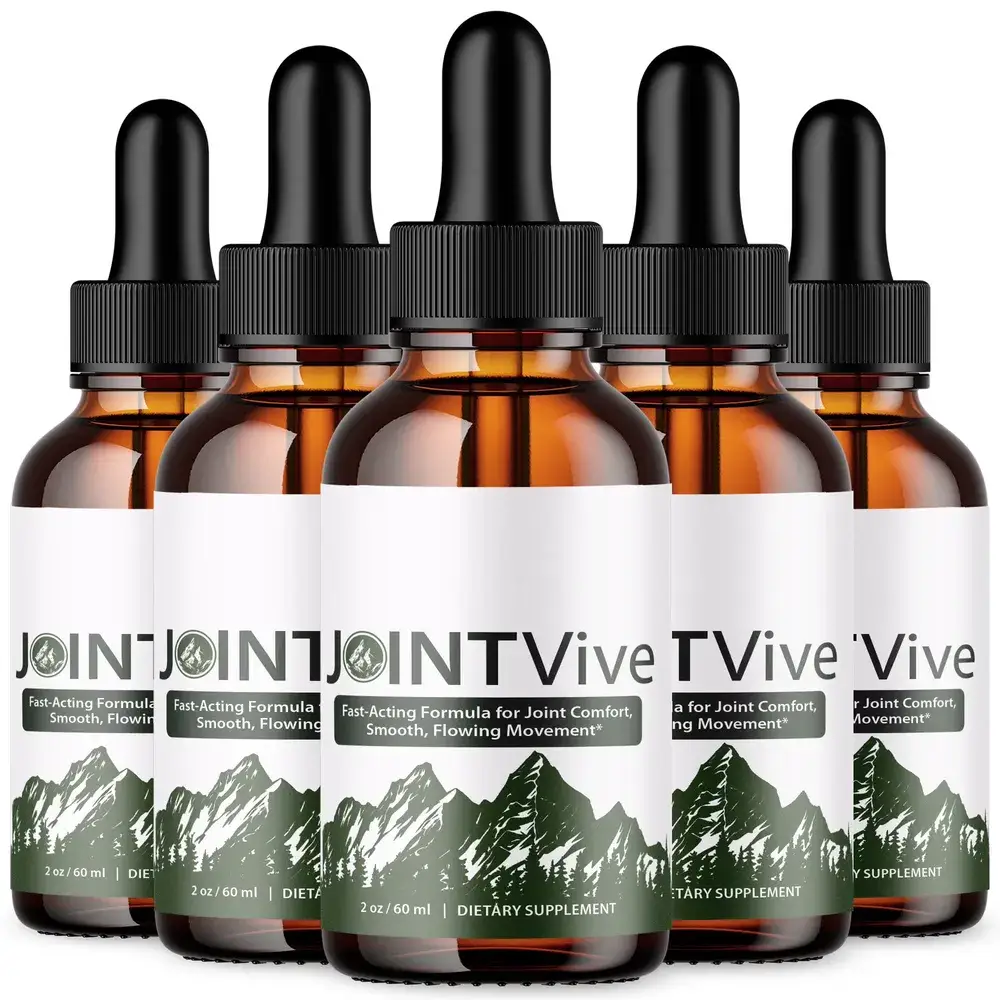
JointVive is the one to look at if the stiffness is the everyday kind — getting up, kneeling, the first flight of stairs — and no doctor has put a name to it. It is a nine-plant liquid led by pine bark extract, taken as drops rather than another capsule, with no stimulants in it. The evaluation window is a full year, which is more room than anyone needs to decide honestly.
Look elsewhere if: You want every milligram printed. The blend is proprietary, so the individual plant amounts are not disclosed — and if you take blood thinners, antiplatelet medication or regular NSAIDs, clear the ginkgo in it with your doctor first.
Joint Genesis
A printed dose, and a route aimed at the joint's own cushioning
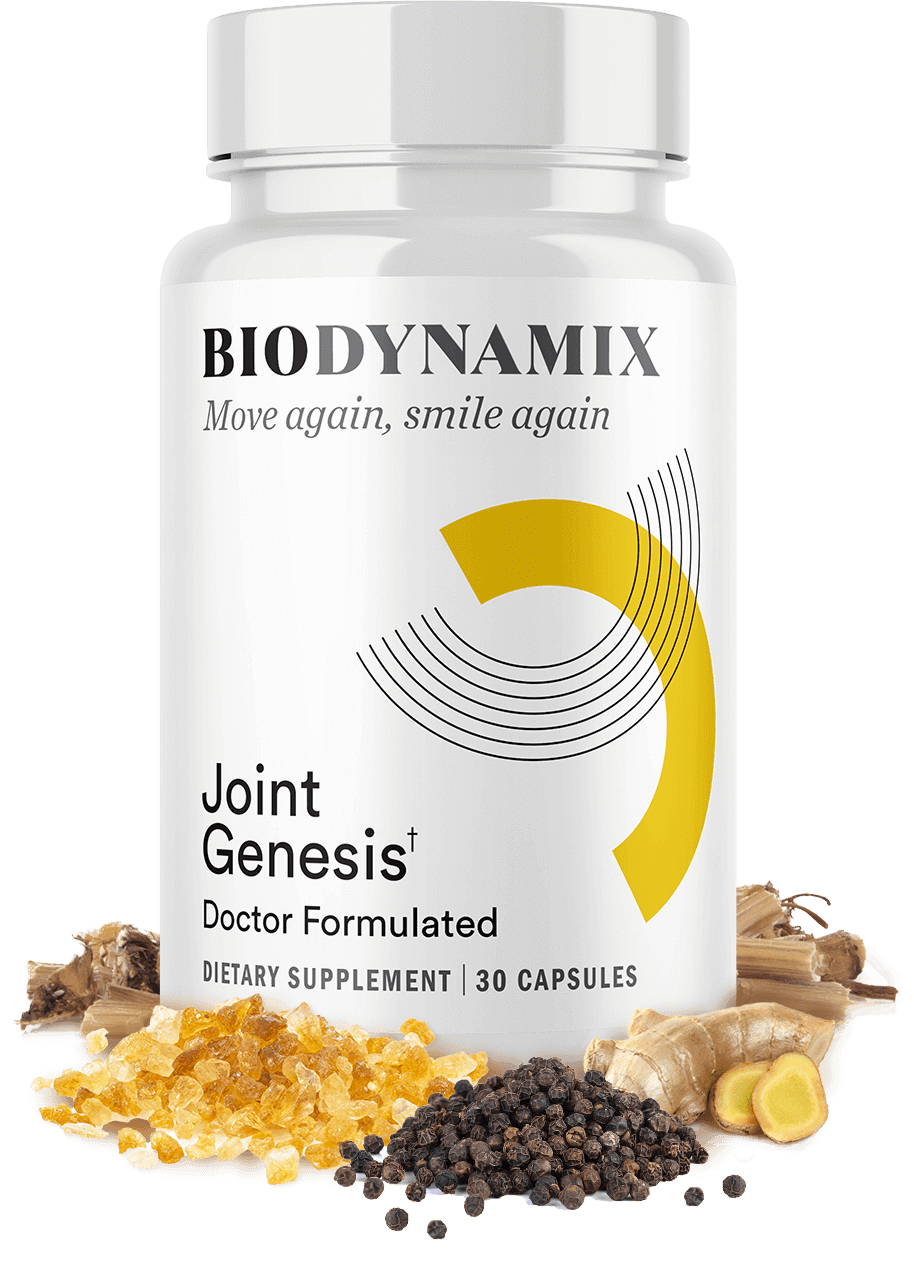
Joint Genesis goes the other way: an open label with the amounts on it — Mobilee hyaluronan at 80 mg, pine bark at 150 mg, ginger, boswellia. Hyaluronan is the route aimed at the fluid that cushions the joint rather than at the tissue around it, and it is the one to pick if glucosamine or collagen already came and went without doing much for you.
Look elsewhere if: Swallowing one more capsule is the thing you are trying to avoid, or you would rather have the longer window to decide in. That is JointVive's lane.
Which one should you start with?
Answer one question and the choice makes itself. If nobody has put a name to your stiffness and you would rather not add another capsule to the morning, JointVive is the straightforward pick — drops, no stimulants, and a full year to decide in. If you have already given glucosamine or collagen a fair run and want to see the amounts printed, Joint Genesis puts its hyaluronan dose on the label and goes at the cushioning directly.
Is a joint supplement worth trying for easier mornings?
Picture the small things you would take back. Kneeling to plug something in behind the sofa and getting up in one movement. Taking the stairs at your own pace instead of the handrail's. Walking the dog at seven without the first five minutes being a warm-up. That is a short and reasonable list, and none of it asks for a different body.
Here is the honest frame. A joint formula is a potentiator, not a switch. It does not replace the moving, the warmth or the sleep position, and it will not undo decades of use. What it does is support the cushioning and the comfort around the joint so that the ordinary measures have more to work with. Taken that way it tends to be worth the money. Expected to act like a painkiller, it will not be.
What makes it worth the attempt is that there is real ground under it. Li and colleagues set out in 2021 how the lubrication inside a joint actually behaves. Cesarone's group found pine bark extract easing stiffness and morning pain in a controlled study in 2024. Cicero and colleagues found oral hyaluronan improving pain and function in a randomized, placebo-controlled trial in 2020. None of that was run on one specific bottle, and none of it is a guarantee. It is enough to say the attempt is informed rather than hopeful.
And the answer is yours rather than an average. Someone of forty-eight who walks every day and sleeps well will read a different result than someone of sixty-four who sits for nine hours — same formula, same weeks. That is not a reason to talk yourself out of it. It is the reason to give it the full window, and the reason the people who notice the most tend to be the ones who kept moving while they took it.
Frequently asked questions
Why do my joints feel stiff when I first get up?
A joint is lubricated by fluid that behaves differently depending on whether you are moving. Hold still for seven or eight hours and that lubrication settles; start moving and it spreads again. That is why stiffness is worst in the first minutes of the day and eases as you go, and why the movement itself is part of the fix.
How long does normal morning joint stiffness last?
The everyday kind is short. A 2023 clinical review in JAMA reports that no morning stiffness, or stiffness lasting under 30 minutes, is a strong pointer toward ordinary wear rather than inflammatory arthritis. NIAMS describes the same pattern: stiffness for a short period after rest or inactivity.
What's the fastest way to loosen stiff joints in the morning?
Move before you ask anything of the joint. Ankle circles and slow knee bends while you are still sitting on the edge of the bed do more in two minutes than standing up cold and hoping. Warmth helps, a walk helps more, and the 2023 JAMA review puts exercise first among the things that work for knee pain.
Is morning joint stiffness a sign of arthritis?
Not on its own. The pattern that matters is duration and symmetry. A 2025 clinical review describes rheumatoid arthritis as prolonged morning stiffness that improves with activity and that shows up on both sides at once. Short stiffness in one knee or one hand is a different story from an hour of it in both wrists.
Can a joint supplement actually help with morning stiffness?
As support, yes, and it is worth setting expectations correctly. A 2024 controlled study found pine bark extract improved stiffness and reduced morning pain in adults with hand osteoarthritis, and a 2020 randomized trial found oral hyaluronan improved pain and function in knee osteoarthritis. These are potentiators alongside movement, not replacements for it.
When should morning joint stiffness be checked by a doctor?
Book an appointment if the stiffness runs past 30 to 60 minutes, if it turns up on both sides at once, or if it comes with swelling, redness, warmth or fever. That combination points toward an inflammatory cause rather than everyday wear, and it is a question for a clinician rather than for a supplement.