
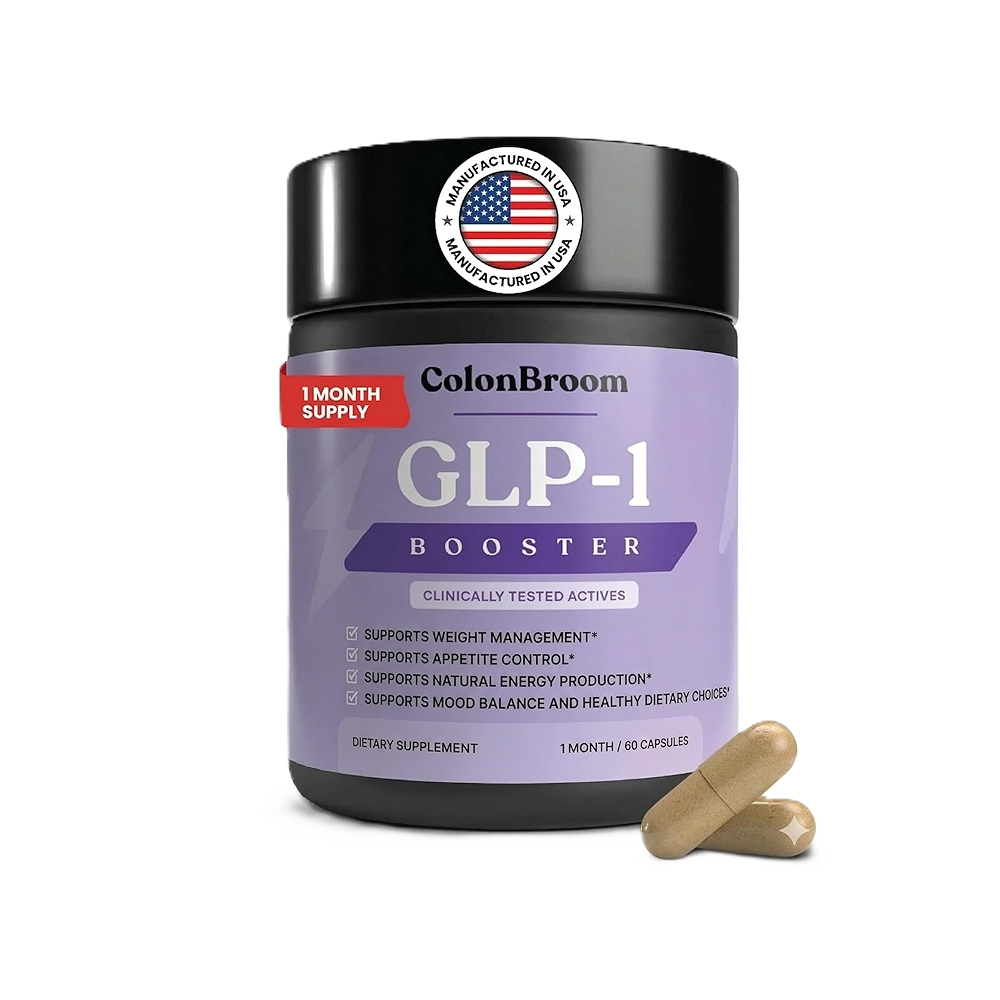
Reviewed by Emily Carter, Contributor — Weight Management & Blood Sugar
Edited by Michael Anderson, Editor-in-Chief ·
Updated
In This Review:
- 1. Product at a Glance
- 2. Appetite, Fiber & GLP-1 After 40: Evidence, Concerns & Trends
- 3. What ColonBroom GLP-1 Booster Does and Benefits
- 4. Why We Rate It 4.4 / 5
- 5. Who It's Best For
- 6. The Mechanism + Full Ingredient List
- 7. Side Effects & Safety
- 8. How It Compares
- 9. Pricing Options for ColonBroom GLP-1 Booster
- 10. Final Verdict
- 11. FAQs
1. Product at a Glance
| Product | ColonBroom GLP-1 Booster |
| Category | Weight Management / Appetite Control / GLP-1 Support |
| Format | Capsules — 2 capsules daily, 60 capsules per bottle |
| Primary Mechanism | Berberine-led blood sugar + insulin sensitivity + appetite support |
| Key Ingredients | Berberine 200mg, Polygonum Cuspidatum 125mg, Quercetin 125mg, Zinc 15mg |
| Manufacturing | USA, Vegan, Gluten-Free, Non-GMO |
| Guarantee | 30-day money-back |
| Our Rating | 4.4 / 5 |
What can you expect?
If you've been curious about Ozempic-style appetite control but don't want injections or a prescription, ColonBroom GLP-1 Booster targets the same general territory — naturally. The formula is built around Berberine, a plant alkaloid with real research on blood sugar, insulin sensitivity, and downstream appetite regulation. Most users notice steadier hunger between meals within 2–4 weeks, with meaningful changes in cravings and portion control by weeks 6–8. This is not a GLP-1 injection replacement — it's a metabolic support formula that borrows the marketing language without the pharmacology. The 30-day guarantee is short by category standards, so plan accordingly.
2. Appetite, Fiber & GLP-1 After 40: Evidence, Concerns & Trends
Before the formula itself, here's what the current evidence, the common concerns, and the market trends actually show about natural GLP-1 support — and where a Berberine-led capsule like this one honestly fits.
| The concern / trend | What the evidence shows | What it means for you |
|---|---|---|
| The body makes its own GLP-1 — and you can nudge it | GLP-1 is a gut hormone that signals fullness and slows gastric emptying. Berberine, the lead active here, activates the AMPK energy pathway and has human evidence for steadier blood sugar and modest weight loss (Yin et al., 2008; Lan et al., 2015 — 27-trial systematic review), with early research suggesting it may indirectly support GLP-1 signaling. Soluble fiber and polyphenols feed the same satiety-hormone machinery from the gut side. | A "natural GLP-1 booster" works by nudging the hormone your body already makes — gradual support for appetite and glucose, not an on/off switch. Real, but on a different scale than an injection. |
| Concern — this is NOT an Ozempic injection | Prescription GLP-1 agonists (semaglutide, liraglutide, tirzepatide) are pharmaceutical drugs dosed for substantial, trial-proven weight loss. No capsule replicates that pharmacology. The "natural Ozempic" framing borrows the marketing language without the mechanism. | Set the expectation correctly: this is metabolic optimization for appetite and cravings, not a needle-free version of a drug. Buyers who expect injection-level results are the ones who end up disappointed. |
| Concern — Berberine ramp-up + dose reality | Berberine commonly causes mild GI effects (stomach upset, looser stools) in the first 1–2 weeks, usually settling when taken with food. And clinical trials run 500–1,500 mg/day — this formula provides 200 mg, designed to work in a multi-ingredient stack rather than as a single mega-dose. | Take it with your largest meal, expect a short adjustment window, and budget 6–8 weeks of consistent use. If you want the full clinical Berberine dose alone, a standalone product fits better. |
| Trend — the post-Ozempic supplement boom (2025+) | As GLP-1 injection costs ($400–$1,000+/month) and access friction pushed buyers to look for alternatives, "natural GLP-1" and "Ozempic alternative" searches surged through 2025 — and so did the products chasing them. The FTC has repeatedly flagged weight-loss supplements for unsubstantiated and "miracle" claims. | The category is crowded and noisy. Full label transparency, disclosed doses, and honest framing (not "replaces Ozempic") are how you separate a credible formula from a bandwagon one. |
Where ColonBroom GLP-1 Booster fits: on the honest side of a loud trend. It discloses every ingredient and dose (no proprietary blends), leads with Berberine — the most-studied compound in the natural metabolic category — and frames itself as appetite and blood-sugar support rather than a drug substitute. The trade-offs to know going in are the sub-clinical 200 mg Berberine dose and the "natural Ozempic" marketing that oversells what any supplement can do. Here's what the formula actually does day to day.
3. What ColonBroom GLP-1 Booster Does and Benefits
ColonBroom GLP-1 Booster solves a single problem: the cravings cycle driven by unstable blood sugar — the 3 p.m. crash, the after-meal sweet pull, the snack reflex that doesn’t respond to willpower. One honest note up front: it does not contain semaglutide, liraglutide, or any pharmaceutical GLP-1 agonist. It’s a phytochemical formula that targets the upstream metabolic factors — blood sugar balance, insulin sensitivity, inflammation — which make appetite control difficult when out of alignment.
Appetite after 35 isn’t just hunger — it’s the consequence of metabolic biology getting noisier. When blood sugar swings, cravings intensify. When insulin sensitivity drops, more calories get stored as fat instead of burned. When chronic inflammation rises, metabolic efficiency falls. Most weight-loss supplements target appetite directly with fillers or stimulants; this one works upstream on the metabolic factors that produce the cravings in the first place.
You feel that metabolic noise in specific ways: the 3 p.m. crash that arrives after a normal lunch. The cookie reflex that hits 90 minutes after dinner. The snack hunger that arrives even though you just ate. The scale that drifts up despite reasonable eating. None of this is willpower failure — it’s glucose curves running wild and pulling appetite signaling along with them.
What ColonBroom builds toward, week by week, is those signals settling — and the payoff shows up as a stack of benefits, ranked here by how much research actually supports each one:
- Steadier blood sugar between meals — the best-supported benefit. Berberine’s AMPK activation smooths the glucose spikes and crashes that trigger impulsive snacking in the first place.
- Fewer cravings, easier portion control — the downstream effect of steadier glucose. When the blood-sugar reward system calms down, the mid-afternoon sugar pull fades and stopping after one serving stops feeling like a fight. This is the change buyers report most.
- Better insulin sensitivity — Berberine and Resveratrol improve insulin response through two different pathways, so more of what you eat gets burned instead of stored around the midsection.
- Antioxidant support for metabolic inflammation — the slow, compounding one. Quercetin and Resveratrol help quiet the low-grade inflammation that keeps insulin resistance locked in.
- Gradual appetite regulation — real but gentle. Berberine may nudge GLP-1 signaling, so hunger patterns soften over weeks. This is not the dramatic appetite shutdown Ozempic users describe.
Steadier energy first, then the 3 p.m. crash softening around week 2–4, then meaningful craving and portion changes by weeks 6–8. The 30-day guarantee is shorter than we’d like for a formula that needs 8 weeks to fully register — factor that into bundle choice. Made in the USA in a GMP-certified facility, with full label transparency and no proprietary blends. How the four pathways actually work →
4. Why We Rate It 4.4 / 5
Every product we review is scored across six criteria focused on product application: ingredients, doses, mechanism, evidence, transparency, and value. ColonBroom GLP-1 Booster earns a solid 4.4 because it uses evidence-aligned ingredients with full label transparency and no proprietary blends. Where it loses points is the sub-clinical Berberine dose (200 mg vs 500–1500 mg in most research), the narrow 4-ingredient formula, and the marketing framing that positions it as a "natural Ozempic" — which oversells what any supplement can do relative to GLP-1 injections.
What stands out:
- Full label transparency — every ingredient and dose disclosed, no proprietary blends
- Berberine as the core — one of the most studied plant compounds for metabolic support
- Resveratrol + Quercetin layer — well-documented antioxidant support for metabolic health
- Clean label — vegan, gluten-free, non-GMO, USA-manufactured, no fillers or stimulants
- Stimulant-free — no caffeine, no jitter, no sleep disruption
Where it falls short:
- Berberine dose is sub-clinical — 200 mg vs the 500–1500 mg range studied in trials
- Narrow 4-ingredient formula — no chromium, no fiber, no established weight-loss stack partners
- "Natural Ozempic" marketing oversells — does not replicate GLP-1 injection pharmacology
- Zinc Oxide form — less bioavailable than Zinc picolinate or bisglycinate
Full scorecard across all 6 criteria: ColonBroom GLP-1 Booster Scorecard →
5. Who Is ColonBroom GLP-1 Booster Best For?
Best match if you:
- Are curious about GLP-1-style appetite control but don't want injections or prescriptions
- Want a Berberine-led metabolic support formula with full label transparency
- Prefer a stimulant-free, vegan, clean-label approach
- Understand that supplements work gradually — not overnight
- Are willing to commit to at least 6–8 weeks of consistent daily use
Look at alternatives if you:
- Want a thermogenic weight loss formula — see CitrusBurn
- Need the full clinical Berberine dose (500–1500 mg) — stack a dedicated Berberine supplement
- Are looking for a true GLP-1 effect — that requires prescription medication, not a supplement
- Have diagnosed diabetes, take blood sugar medication, or are on blood thinners (consult your doctor first)
6. The Mechanism + Full Ingredient List
Most metabolic supplements pick one mechanism — usually berberine’s AMPK activation alone — and bet everything on it. That works partially, but the metabolic noise behind cravings has multiple drivers. ColonBroom runs four pathways in parallel, each addressing a different upstream factor that makes appetite control difficult.
AMPK Activation (Berberine). Berberine activates AMPK, the cellular energy sensor that signals cells to burn fuel more efficiently and store less as fat. This is the strongest individually-researched pathway in the formula. Honest note: the 200 mg dose is below the 500–1500 mg range used in most berberine clinical trials — the formula is designed for the AMPK signal as part of a multi-ingredient stack, not as a single-ingredient mega-dose.
Insulin Sensitivity Support (Berberine + Resveratrol from Polygonum Cuspidatum). Better insulin response means less glucose stored as fat and steadier energy between meals. Insulin sensitivity is the variable that determines whether calories you eat get burned for energy or stored as fat. Both berberine and resveratrol have research support here; combining them addresses the same target from two angles.
Antioxidant Protection (Quercetin + Resveratrol). Reduces metabolic inflammation that interferes with weight regulation. Chronic low-grade inflammation directly drives insulin resistance — addressing the inflammation side compounds the insulin sensitivity gains from the prior layer. Quercetin specifically has flavonoid activity studied in metabolic and cardiovascular research.
Mineral Cofactor Support (Zinc). Essential for hundreds of metabolic enzymes, including those involved in insulin signaling. Zinc deficiency directly impairs the insulin pathway — even with the best berberine + resveratrol stack, missing the cofactor means hitting a ceiling. This is the foundation layer most metabolic formulas skip.
The “GLP-1 Booster” framing comes from research suggesting berberine may indirectly influence GLP-1 signaling. The effect is plausible biology but mild compared to prescription GLP-1 agonists like Ozempic. The honest read: this is metabolic optimization, not synthetic GLP-1 mimicking.
How it runs together: the AMPK pathway tells cells to burn more efficiently. The insulin pathway makes sure calories don’t get stored as fat instead. The antioxidant pathway reduces the inflammation that breaks both pathways. The cofactor pathway ensures the enzymatic machinery is present. Four pathways means each driver gets addressed — instead of betting everything on berberine alone.
Full Ingredient List
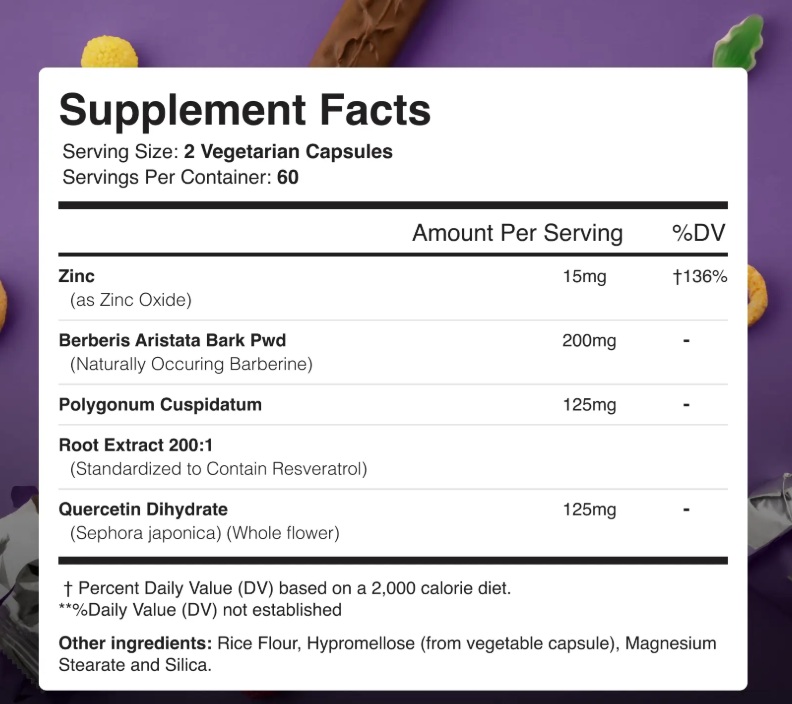
The label is fully disclosed — no proprietary blend hiding individual doses. Here’s every active, its amount, and the pathway it serves:
| Ingredient | Amount | Role in the formula |
|---|---|---|
| Berberine (Berberis aristata bark) | 200 mg | Plant alkaloid and cornerstone of the formula. Activates AMPK — the cellular energy sensor — to improve insulin sensitivity and glucose handling, with research suggesting an indirect nudge to GLP-1 signaling. |
| Polygonum Cuspidatum Extract (200:1) | 125 mg | Standardized resveratrol source. Activates SIRT1, a metabolic regulator that works alongside AMPK to improve insulin response and reduce metabolic inflammation. |
| Quercetin Dihydrate | 125 mg | Flavonoid antioxidant that quiets the chronic low-grade inflammation that drives insulin resistance and interferes with the “I’m full” signal. |
| Zinc (as Zinc Oxide) | 15 mg (136% DV) | Essential cofactor for insulin-signaling enzymes. The foundation layer most metabolic formulas skip — even the best stack hits a ceiling without it. Zinc Oxide is a less bioavailable form than picolinate or bisglycinate, a minor optimization point. |
What these terms actually mean:
- AMPK
- Your cells’ fuel gauge. When it’s high, cells burn glucose and fat for energy; when it’s low (common with insulin resistance), they store calories as fat instead. Berberine pushes the gauge back toward burning — the same general lever the diabetes drug metformin pulls.
- Insulin sensitivity
- How well your cells respond to insulin’s “take in this glucose” signal. High sensitivity means the food you eat gets used for energy; low sensitivity (resistance) means more of it gets shunted into fat storage, especially around the midsection.
- GLP-1
- A gut hormone your body makes on its own that signals fullness and slows how fast the stomach empties. Prescription drugs like Ozempic flood the system with a synthetic version; a “booster” like Berberine can only gently nudge the amount you already produce — real, but on a far smaller scale.
- SIRT1
- A second metabolic regulator, switched on by resveratrol. It works next to AMPK to sharpen insulin response and calm inflammation — which is why pairing Berberine with a resveratrol source hits the same target from two angles.
Dose Reality Check
The honest caveat behind the 4.4 rating: the 200 mg Berberine dose sits below the 500–1,500 mg range used in most Berberine clinical trials. That’s intentional — the formula is designed for the AMPK signal to work in combination with Resveratrol, Quercetin, and Zinc, not as a single-ingredient mega-dose. Four levers pushed together is the premise. But it also means the effect is proportionally milder than a full clinical Berberine dose, and it’s the main reason this is metabolic support, not a drug substitute. If you believe you need a stronger single-ingredient concentration, that’s a conversation for your doctor — not a DIY call, especially since higher Berberine doses come with more GI discomfort and benefits that appear to plateau well before the top of that range.
Results Timeline — What to Expect and When
Berberine’s effects build over weeks, not days — the single biggest reason people quit too early. This timeline reflects the pharmacology of the ingredients plus common user-reporting patterns; individual results depend on baseline metabolic health, diet, and consistency.
| Timeline | What to expect |
|---|---|
| Weeks 1–2 | Loading phase. Berberine is accumulating in tissue. Some users notice mild digestive effects — looser stools, bloating — during this window; they’re normal and usually settle when the capsule is taken with food. Appetite feels roughly the same, with a mild dip in sugar cravings possible by the end of week 2. |
| Weeks 3–4 | Early signals. Blood sugar stabilization starts to show — mid-afternoon crashes happen less often, sugar cravings feel less intense, and portion sizes may drift naturally smaller. This is where most people form their first real opinion. |
| Weeks 5–8 | Peak adaptation. Insulin-sensitivity gains from Berberine + Resveratrol compound. Most reports of measurable change cluster here: modest weight loss (typically 2–5 lbs), easier portion control, and less “food noise” overall. This is the real window to judge the formula. |
| Beyond 8 weeks | Maintenance. Continued daily use sustains the metabolic adaptation; the 6-bottle bundle is built around this horizon. Stopping abruptly unwinds the effect gradually over the following 4–6 weeks. |
The takeaway: weeks 5–8 are where you judge this product — anything before that is too early, and the 30-day guarantee window is genuinely too short for the timeline. Results also aren’t built in a vacuum. Taking the capsule 15–30 minutes before your largest meal (to blunt the post-meal glucose spike), keeping refined carbs down, sleeping 7+ hours, walking 20 minutes a day, and staying consistent all directly amplify what the formula can do. If you’re at week 8 of consistent use with no change, either blood sugar wasn’t what was driving your cravings, or you may need the higher clinical dose — a doctor conversation, not a DIY one.
7. Side Effects & Safety
For healthy adults not on medication, ColonBroom GLP-1 Booster has a clean safety profile at the 200 mg Berberine dose. It’s vegan, gluten-free, non-GMO, stimulant-free, and made in the USA — so no jitters, no heart-rate bump, and no sleep disruption the way thermogenic fat-burners cause. The most common report is mild digestive sensitivity in the first 1–2 weeks: looser stools, bloating, or cramping. That’s the well-documented Berberine ramp-up, not a red flag — it usually fades as your body adapts, and taking the capsule with food (rather than on an empty stomach) reduces it for most people.
Possible Side Effects
| Side effect | Likelihood | What to do |
|---|---|---|
| Mild GI discomfort (loose stools, bloating, cramping) | Common (weeks 1–2) | The normal Berberine ramp. Take with food; it usually resolves after the first week as the body adapts. |
| Constipation | Rare | The opposite effect in some people — Berberine’s impact on gut motility varies by individual. Stay hydrated. |
| Mild nausea | Uncommon | Take before meals rather than on an empty stomach. Usually resolves within the first week. |
| Headache | Rare | Reported by a small minority in the first few days of adjustment. Stay hydrated. |
| Low blood sugar (with diabetes medication) | Real concern if combined | Berberine lowers glucose; stacked with metformin, insulin, or sulfonylureas it can push blood sugar too low. Consult your doctor first. |
None of these are common at the 200 mg dose — most users experience mild or no side effects. Any severe or persistent reaction is a reason to stop and see a doctor. The manufacturer doesn’t publish third-party lab testing on the public site (common in the category, but clearer disclosure would strengthen confidence); the fully transparent, dose-disclosed label is a genuine offsetting positive.
Check With Your Doctor First If…
The bigger safety story with any Berberine product isn’t side effects — it’s drug interactions. Berberine is potent enough to matter. Talk to your physician before starting if any of these apply:
- Diabetes medication (metformin, insulin, sulfonylureas, SGLT2 inhibitors, or GLP-1 agonists like Ozempic/Wegovy/Mounjaro) — Berberine compounds their glucose-lowering effect and can cause hypoglycemia.
- Blood thinners (warfarin, apixaban) — Berberine may affect platelet function and anticoagulant activity.
- Immunosuppressants or certain antibiotics/antifungals — Berberine inhibits CYP3A4, the liver enzyme that processes cyclosporine, tacrolimus, and several other drugs.
- Liver or kidney disease, or heart-rhythm problems — Berberine is liver-metabolized, and high doses have been linked to QT prolongation in rare cases.
- Pregnancy or breastfeeding, or under 18 — Berberine is contraindicated; it can cross the placenta and isn’t studied for children.
If none of that applies, there’s no medical reason to hesitate. And a caution that outranks any supplement: any rapid or unexplained weight change should be evaluated by a physician — a supplement is not a substitute for medical care. Full scorecard and buyer feedback: ColonBroom GLP-1 Booster Pros & Cons →
8. How It Compares
| Criteria | ColonBroom GLP-1 Booster (this) | CitrusBurn | SlimLex GLP-1 |
|---|---|---|---|
| Primary Focus | Appetite + blood sugar | Thermogenic fat burn | GLP-1 hormone via gut bacteria |
| Key Mechanism | Berberine + AMPK pathway | Citrus bioflavonoids (thermogenesis) | Akkermansia → P9 protein → GLP-1 |
| Format | Capsule daily | 1 capsule daily | Capsule daily |
| Best Price | $39.99/bottle | $49/bottle | $39.95/bottle |
| Guarantee | 30 days | 180 days | 60 days |
| Best For | Phytochemical AMPK angle | Slow metabolism + cravings | Probiotic gut-based GLP-1 boost |
Honest take: these aren't direct competitors — they target weight loss through three different biological pathways. ColonBroom uses berberine to activate AMPK + modest GLP-1 effect. CitrusBurn uses citrus bioflavonoids for thermogenesis and metabolic boost. SlimLex GLP-1 uses Akkermansia probiotic + P9 protein to stimulate the body's natural GLP-1 production directly at the gut level. If you want phytochemical AMPK → ColonBroom. Thermogenic + appetite → CitrusBurn. Probiotic + the closest non-prescription GLP-1 angle → SlimLex.
9. Pricing Options for ColonBroom GLP-1 Booster
ColonBroom GLP-1 Booster is available in multiple package options designed to support different usage timelines. Many users choose multi-bottle packages because consistent daily use typically delivers the best results. Longer supply options also reduce the cost per unit.
1 Bottle
30-Day Supply
- 30-day Money-Back Guarantee
- Free USA Shipping
- Secure Checkout
6 Bottles
180-Day Supply
- 30-day Money-Back Guarantee
- Secret Gift
- Free USA Shipping
- Secure Checkout
Save 53%
Shop Now3 Bottles
90-Day Supply
- 30-day Money-Back Guarantee
- Secret Gift
- Free USA Shipping
- Secure Checkout
Save 36%
Shop NowEvery order is backed by a 30-day money-back guarantee. Only available through the official website.
10. Final Verdict
ColonBroom GLP-1 Booster earns our 4.4 rating because it delivers exactly what it promises: a clean, transparent, Berberine-led formula for adults who want natural appetite control without prescriptions, injections, or stimulants. Berberine is one of the most evidence-backed plant compounds for blood sugar balance and metabolic support — and this formula pairs it with Resveratrol, Quercetin, and Zinc to hit four complementary pathways at once.
Real buyers consistently report reduced cravings, easier portion control, steadier energy between meals, and gradual fat loss over 6–8 weeks of consistent use. The label is fully transparent (no proprietary blends), the formula is vegan and non-GMO, and it's manufactured in the USA. For the right buyer — adults curious about GLP-1-style appetite control who want a natural, stimulant-free approach — this is one of the cleaner options on the market.
Our recommendation: the 6-bottle bundle at $39.99/bottle is the best value and matches the realistic 6-month window where Berberine's effects compound. The 3-bottle bundle is a solid middle ground if you want to test before committing. Both include free US shipping and the Secret Gift bonus. Results take a few weeks to build — stay consistent, take the capsules with your largest meal, and let the formula do its work.
11. Frequently Asked Questions
Is ColonBroom GLP-1 Booster the same as Ozempic?
No. Ozempic (semaglutide) is a prescription pharmaceutical GLP-1 agonist with clinical trial evidence for substantial weight loss. ColonBroom GLP-1 Booster is a dietary supplement built around Berberine and does not contain semaglutide, liraglutide, or any prescription GLP-1 drug. The "GLP-1 booster" name refers to research suggesting Berberine may indirectly support GLP-1 signaling — a much milder effect than prescription injections. Manage your expectations accordingly.
How long until I see results?
Subtle changes (steadier hunger, reduced sugar cravings) can appear in 2–4 weeks. Meaningful changes in weight and portion control typically emerge between weeks 6 and 8, matching the timeline in Berberine research. Full timeline: Results Timeline →
Is the Berberine dose enough?
ColonBroom GLP-1 Booster delivers 200 mg of Berberine per serving, chosen to work in combination with Resveratrol, Quercetin, and Zinc — not as a standalone mega-dose. The multi-pathway approach is the whole point of the formula: Berberine activates AMPK, Resveratrol activates SIRT1, Quercetin reduces metabolic inflammation, and Zinc supports insulin signaling. Together they hit several metabolic levers at once. Higher single-ingredient Berberine doses (500–1500 mg) exist in research literature but are still being studied for long-term safety and real-world benefit. If you believe you need a stronger concentration of just one ingredient, that's a conversation for your doctor — not something to DIY. Details: Full Ingredient List & Dose Reality Check →
Where should I buy it?
Only through the official website. Third-party sellers are not authorized and don't qualify for the 30-day money-back guarantee.
When should I talk to a doctor before taking ColonBroom GLP-1 Booster?
If you have diagnosed diabetes, take insulin or blood sugar medication (metformin, sulfonylureas, GLP-1 agonists), have liver disease, or take blood thinners, talk to your physician before starting any Berberine-containing supplement. Berberine can interact meaningfully with these drugs. The same applies if you're pregnant, breastfeeding, under 18, or have a history of eating disorders. For any rapid or unexplained weight changes, see a doctor — a supplement is not a substitute for medical evaluation.
INGREDIENT TAGS
Research & Transparency
This review is based on publicly available ingredient research, manufacturer disclosures, and product labeling. We are not affiliated with the ColonBroom brand. Below is a summary of the scientific evidence behind the four active ingredients in the GLP-1 Booster formula, organized by benefit area.
Blood sugar & insulin sensitivity (Berberine)
Berberine has one of the strongest individual evidence bases in the natural metabolic category. A 2008 randomized trial (Yin et al.) showed Berberine at 500 mg three times daily produced glucose-lowering effects comparable to metformin in adults with type 2 diabetes. A 2015 systematic review (Lan et al.) confirmed Berberine's effects on fasting glucose, HbA1c, and insulin resistance across 27 trials.
Weight management & appetite regulation (Berberine, Resveratrol)
Berberine's AMPK activation mechanism (the same pathway targeted by metformin) has been linked to modest weight loss in overweight adults over 12 weeks. Resveratrol from Polygonum Cuspidatum activates SIRT1 — a complementary metabolic regulator — and a 2020 meta-analysis (Ramírez-Garza et al.) showed improvements in insulin sensitivity and visceral fat reduction.
Antioxidant & anti-inflammatory support (Quercetin, Zinc)
Quercetin is one of the most studied flavonoids for metabolic syndrome markers. Zinc is a cofactor for insulin signaling enzymes; inadequate zinc status independently impairs glucose handling in research populations. Together they address the chronic low-grade inflammation that drives insulin resistance.
Honest note on the Berberine dose
The clinical research on Berberine typically uses 500–1500 mg per day. ColonBroom GLP-1 Booster provides 200 mg per serving. Effects are likely present but proportionally smaller than what the research shows. No supplement in this category replicates prescription GLP-1 agonists (semaglutide, liraglutide, tirzepatide). The "natural Ozempic" framing is marketing language, not a clinical claim.
(a) Yin J, et al. Efficacy of Berberine in Patients with Type 2 Diabetes. PMC2410097
(b) Lan J, et al. Meta-analysis of the effect and safety of Berberine in glucose and lipid metabolism. PMC4500981
(c) Ramírez-Garza SL, et al. Health Effects of Resveratrol: Results from Human Intervention Trials. PMC7084498
(d) Shabbir U, et al. Quercetin and its role in chronic diseases. PMC7146259
(e) Fernández-Cao JC, et al. Zinc intake and status in insulin resistance. PMC6470772
About the Author
Emily Carter is a contributor at The Supplement Post and a research collaborator with the Smart Guide editorial group — an independent team dedicated to conducting deeper evaluations of supplements across major health categories. Her work covers weight management, blood sugar control, brain health, and evidence-aware supplement analysis. She is not a medical doctor — she analyzes publicly available research to provide consumer-friendly summaries for adults exploring metabolic and appetite support options.
Disclosure
All content is for informational purposes only and is not a substitute for professional medical advice. Each product reviewed is a dietary supplement, not a prescription drug. Results may vary based on individual health status, consistency of use, and lifestyle. This page may contain affiliate links — if you purchase through them, we may earn a small commission at no additional cost to you. Read our Editorial Policy.